

furthermore (1999)
If you’ve been following the blog for a while, you’ll know that by 1999, pianist Andrew Burashko and dancer Peggy Baker had been touring Canada and the USA together for almost a decade. They often included a piano work for Andrew to perform without any dance, and in this week’s blog Peggy recounts how Andrew’s choice of Piano Music No. 2 by John Cage led to the creation of furthermore:
“For this particular composition, Cage had employed the chance procedure of taking flaws in the manuscript paper on which he was notating and assigning them musical notes, some of which would be played on the keyboard, and some by striking or plucking the string directly, reaching inside piano. This piece therefore required that the musician stand at the piano in order to be able to play both the keyboard and the strings simultaneously, while also shifting their weight to extend a leg to work the pedals that sustain or dampen notes. I found the movements required of Andrew quite beautiful, and highly choreographic.
In the fall of 1999 Andrew presented his first recital program for a new music performance initiative under his artistic direction, Art of Time Ensemble. Contemporary music by Americans John Cage, Peter Lieberson, George Crumb, Sebastian Currier ,and George Gershwin was brought together in a program titled Fascinatin’ Rhythms. Along with Andrew, the stellar musicians on the program included Steve Dann (viola), Beverley Johnston (percussion), Barbara Hannigan (soprano), and Joel Quarrington (double bass). I danced to Cage’s Piano Music No. 2, and my choreography was an elaboration on Andrew’s actions so that the work became both a piano solo and a movement duet. I titled the premiere and, moreover, and later renamed it furthermore, though I can no longer imagine why I thought it needed to be changed…” PB
To read more about how John Cage redefined music, visit NPR here.
Art of Time Ensemble has become a live performance juggernaut in Toronto. Andrew’s company presents an annual season of concerts that fuse high art with popular culture. To listen to a selection of their recordings visit Soundcloud here, or their YouTube channel.


Notes on a Collaboration
For this week’s blog, Peggy’s collaborator for twenty years, pianist Andrew Burashko looks back at their prolific partnership:
When I first met Peggy in January of 1991, I was at the threshold of a career as a concert pianist - a career I only ever imagined as a soloist, sometimes sharing the stage with other musicians - a solitary pursuit with not much room for anything else. I knew nothing of modern dance or any other kind of dance for that matter; and I only knew of Peggy Baker as the ex-wife of the composer Michael J. Baker with whom I had worked.
Peggy had just returned to Canada after a decade in New York and was looking for a pianist to perform a work that Mark Morris had given her as a gift when she left White Oak Dance Project. It was a work titled Ten Suggestions which was choreographed for solo dancer to Ten Bagatelles for solo piano by Alexander Tcherpnin. When Peggy first reached out to me, I saw it as a gig that would earn me some sustenance between ‘real’ engagements - solo recitals and concerto appearances. It seemed like a compromise - a job for a pianist incapable of commanding the stage on their own. This was my fragile, young ego talking, of course.
I remember showing up at the first rehearsal with a metronome to capture the exact tempi Peggy wanted, imagining that I would need to follow her. It was a relief to learn that she wanted me to play the music as I felt it. That was the beginning. For the next twenty years of our collaboration she encouraged me to choose the music – pieces I yearned to play – and allowed for my interpretations to inform her choreography. It was a revelation to see the music I was playing manifested in her movement. Not only in terms of her expression but also as a counterpoint. When making music with other musicians, everyone must be on the same page emotionally and intellectually. It’s not possible for one musician to be still or serene while a musical storm is raging around them. It was a shock to see her choreography seemingly contradict instead of mirror my idea of what the music was saying. It brought another level of nuance to my understanding of music.
Peggy also revealed an entirely new world to me by exposing me to the remarkable discipline and beauty of dance; and by helping me discover a new paradigm for myself as a classical musician. She brought me out of the spartan environment of the concert hall and into the magical and mysterious world of the theatre – lighting, staging, the possibilities of creating another world for the music – things I had never considered before and that I embraced and incorporated into Art of Time concerts.
The lessons were plenty and the growth profound. In short, I wouldn’t have found the path I am on today without having met Peggy.
Thank you dear friend. AB

Why the Brook Wept (1996)
As Peggy Baker and Andrew Burashko continue developing their repertoire together, Andrew suggests another John Cage score, Ophelia, composed for the American dancer Jean Erdman in 1946. Peggy writes about her response:
“That the music had been written explicitly for a choreographic portrait of Ophelia from Shakespeare’s Hamlet was both compelling and intimidating, and I hesitated to take it on. But the more I listened to the music, the more amazed and fascinated I was by the ways in which it captured Ophelia’s dilemma. Finally, I could not turn away.
To begin with, I worked strictly with the script of the play developing sequences, scenes and images based on the text. Once I had worked my way through the words I went back to the music, allowing the score to guide me in arranging, distilling, and refining the choreography. Also very much on my mind was the John Everett Millais painting Ophelia, (1851-2), which I had seen at the Tate in London many years earlier. I chose not to research the original choreography, so there are no intentional allusions to Erdman’s dance in my own. The description of Ophelia’s death as a fall “into a weeping brook” inspired my title.
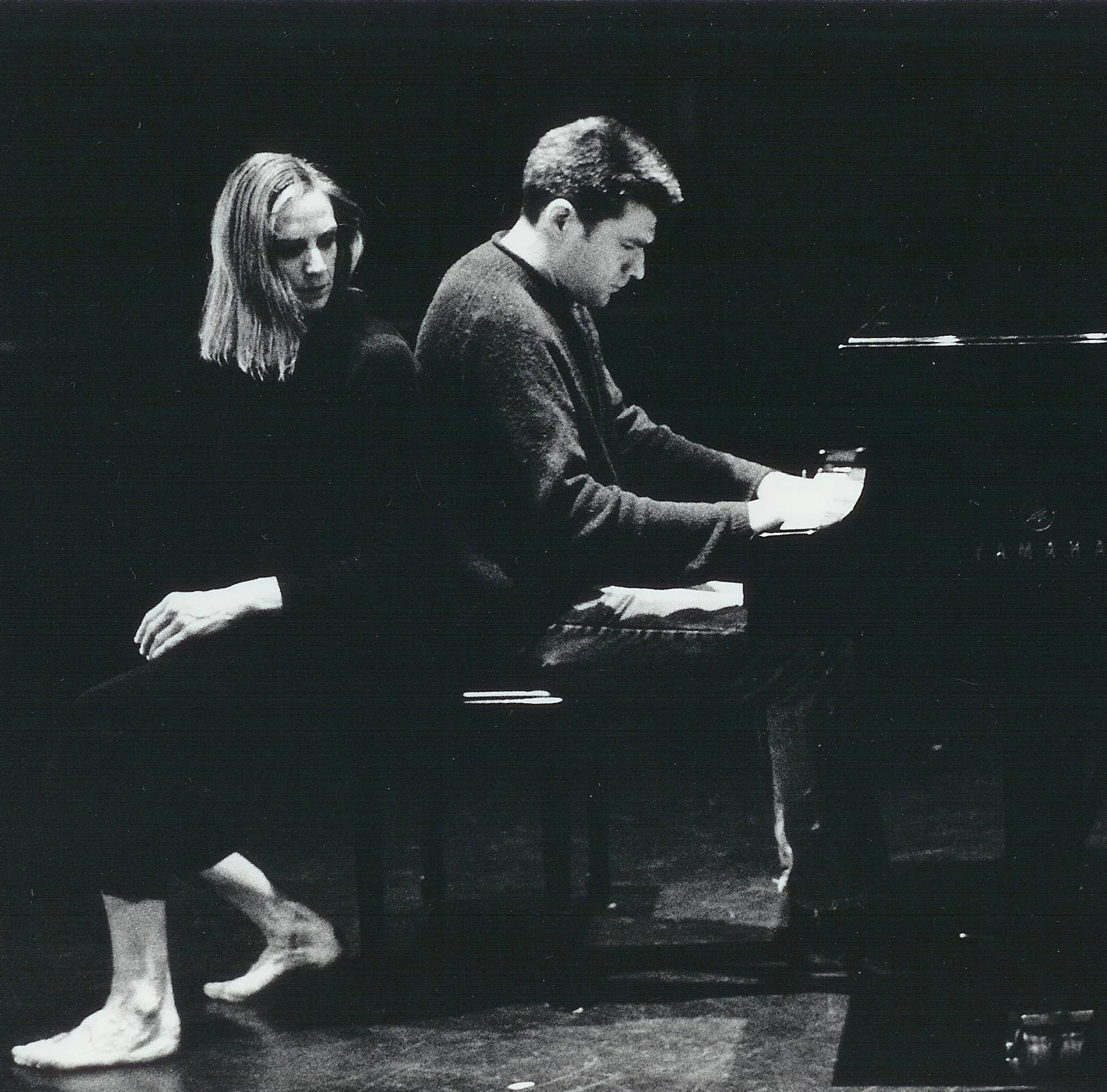
One of the most potent images the music inspired for me was the idea of the pianist as Hamlet, and his performance of the score as his own wrenching self-interrogation. So the piano is positioned in profile on stage left, with the pianist’s back is to the dancer. At the end of the piece, the dancer is left on the floor, crumpled against the back legs of the piano bench, and once the final notes have decayed, the pianist closes the keyboard, stands and closes the piano’s lid and exists the stage. Whenever we performed this work, it closed the program, including on Art of Time Ensemble’s program, If music be… first staged in 2010.” PB
“The two dance sequences are beautifully rendered: Tanya Howard and Patrick Lavoie, as choreographed by James Kudelka in the Act III scene where Romeo and Juliet part after a night of lovemaking; and the remarkable Peggy Baker dancing Ophelia’s madness to music of John Cage to close the show.”
- John Terauds, The Toronto Star
"Cage composed the music for a 1946 dance by Jean Erdman, but Baker has made it her own, as much acted as danced. She passes through a full spectrum of moods, from languor to frenzy. When Burashko closes the piano and leaves her fallen figure on the stage, it is the spirit leaving the body."
- Susan Walker, The Toronto Star
To learn more about the work of John Cage watch John Cage. From Zero here on Youtube.


