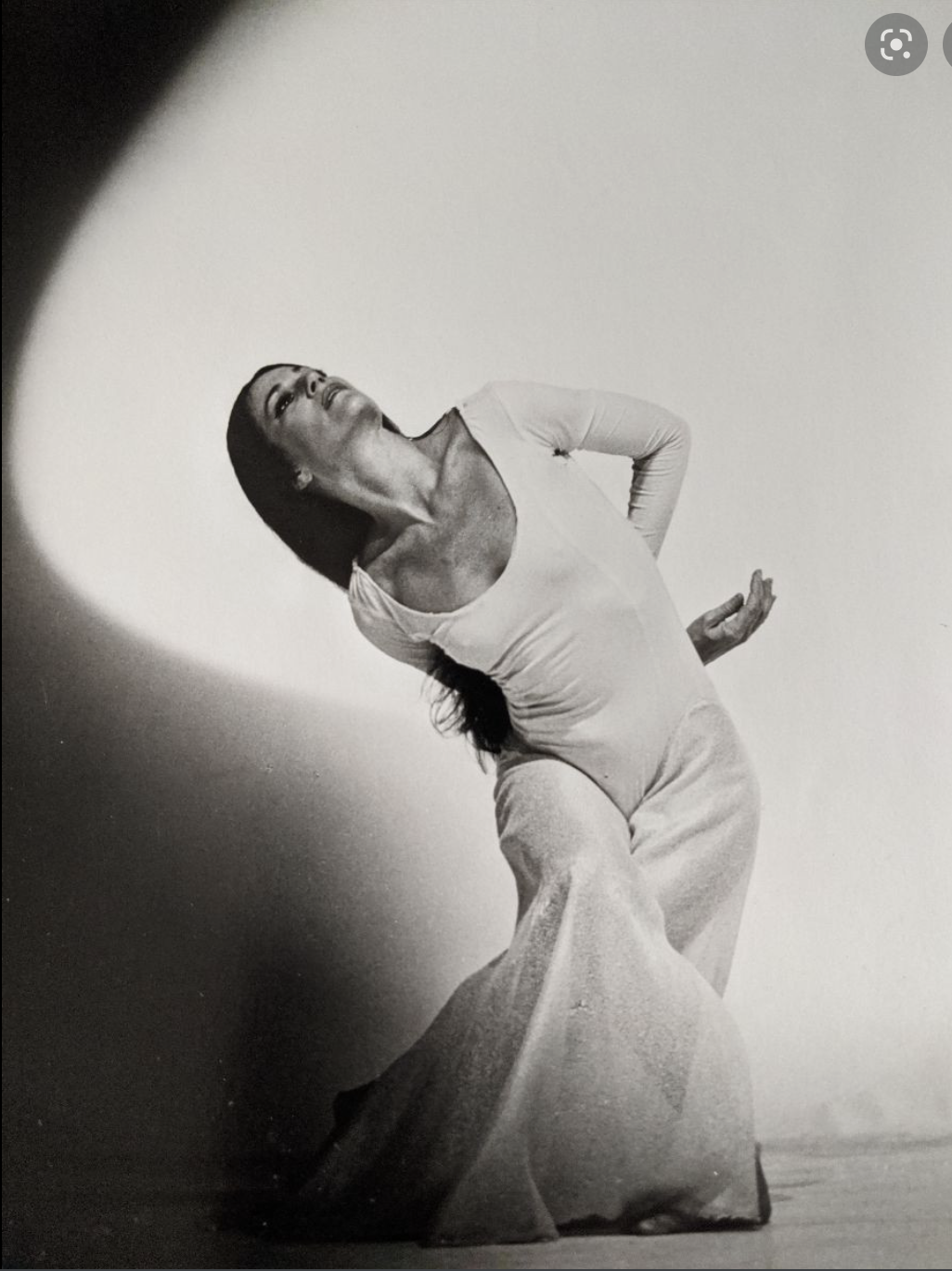

unmoored (2018)
This week we hit the final solo that Peggy commissioned for- and performed- herself. A sequel to a work she premiered 14 years previously. Peggy writes:
In 2003 I turned to the extraordinary dance artist Sarah Chase to make a work for me. Sarah creates in a genre she describes as dancestories, and prior to working together she set me the task of writing two stories for every year of my life. When the time came to go into the studio together, I told Sarah that there was one aspect of my life that I hadn’t written about and could not share in the public sphere. Sarah agreed to my caveat, and we went on to create a very beautiful work titled The Disappearance of Right and Left. More than a decade later I went back to Sarah to let her know that I was now ready to think back on the events that I had previously held apart and to mindfully look to those events as the basis for the creation of a new dancestory.
In March of 2017, I sat down at a desk, in a small room, in the Bogliasco Foundation villa, where I was undertaking a 5-week fellowship in Italy. Guided by Jane Hirschfield’s extraordinary book Nine Gates: Entering the Mind of Poetry , I wrote down the stories I had not been previously ready to share. At the end of my residency I arranged the stories in a rough performance draft – incorporating some initial movement devised by Sarah – and shared the in-progress work that included a poem by Rumi as the final scene, with the other Bogliasco Foundation fellows.
In the months that followed, Sarah and I worked together to develop a choreographic staging to frame and hold a distillation of my writing as a dancestory titled unmoored. The episodes that I recount in unmoored describe events during the 20-year arc of my marriage to the musician, composer, and disability rights activist, Ahmed Hassan. The complex and emotionally charged themes of disability, caregiving, and death at the heart of this work are handled by Sarah with tremendous sensitivity.
One of the poems included in Hirschfield’s book struck an especially deep chord with me. This poem by the 13th century Japanese Zen master Eihei Dogen captures something essential about the utter emptiness of loss, and of how that empty space can in fact offer an opening for illumination:
unmoored
in midnight water
no waves, no wind
the empty boat
is flooded with moonlight
In addition to the Bogliasco Foundation in Liguria, Italy, unmoored was created with the invaluable support of residencies at Tiamat House on Hornby Island B.C., (through the generosity of Judith Lawrence); and Ottawa Dance Directive, Artistic Director Yvonne Coutts / Associate Director Lana Morton.
unmoored premiered at The Theatre Centre in Toronto, with subsequent presentations at The Citadel (Toronto), EDAM (Vancouver), ArtSpring (Salt Spring Island B.C.) Crimson Coast Dance (Nanaimo), and Ottawa Dance Directive.
Winner - Dora Mavor Moore Award for Outstanding Performance in a Dance Production: Peggy Baker
“The work is one of total perfection as the heartbreaking text and Baker’s eloquent movement swing back and forth between darkness and light. “ Paula Citron
“Chase has shaped a performance that Baker speaks, sometimes reading, sometimes reciting, raw in its emotion and polished in its performance. As an artist, Baker needed to make this dance story, for it marks the renewal of creativity, going forward with undying love on the wings of Rumi.” Susan Walker
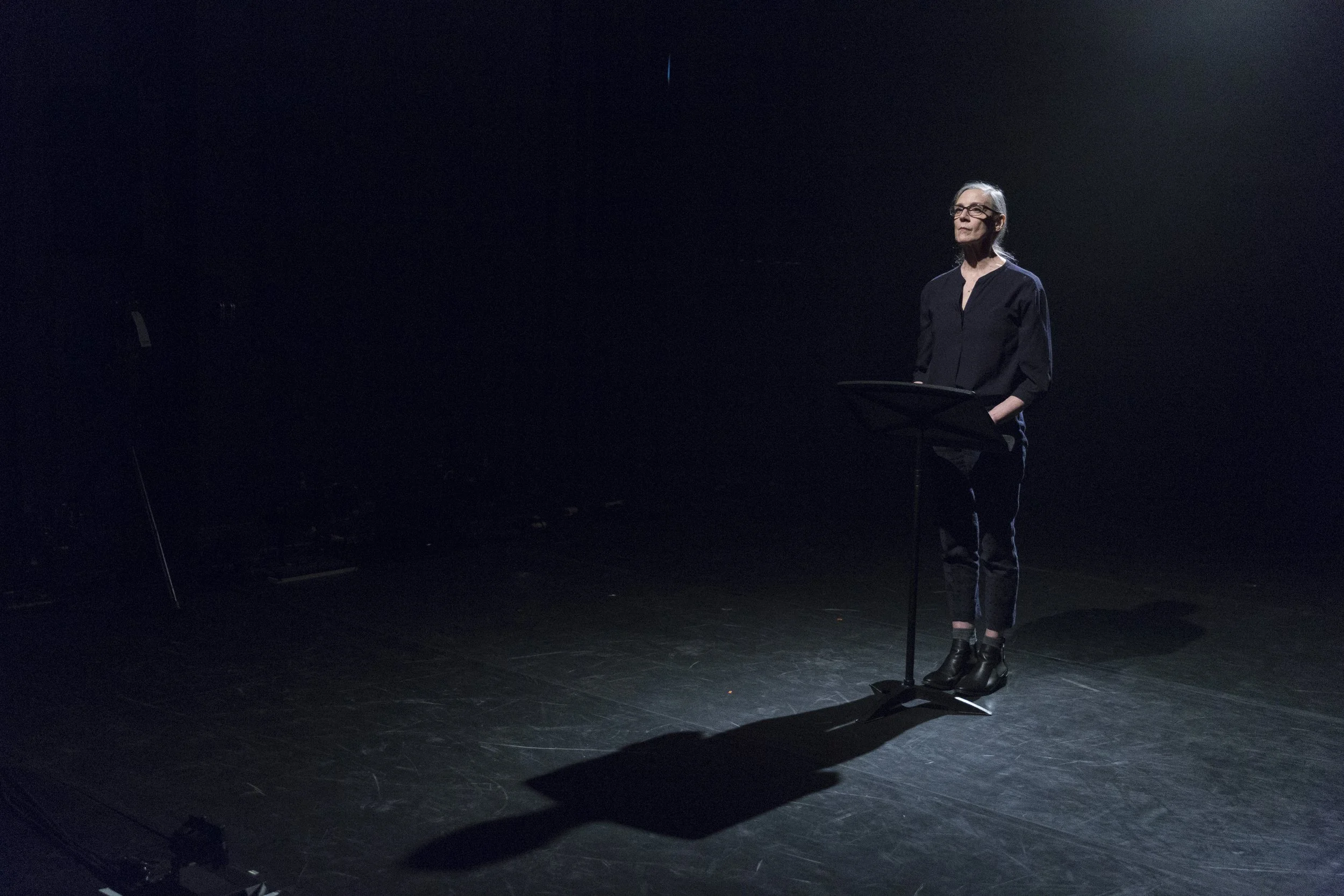
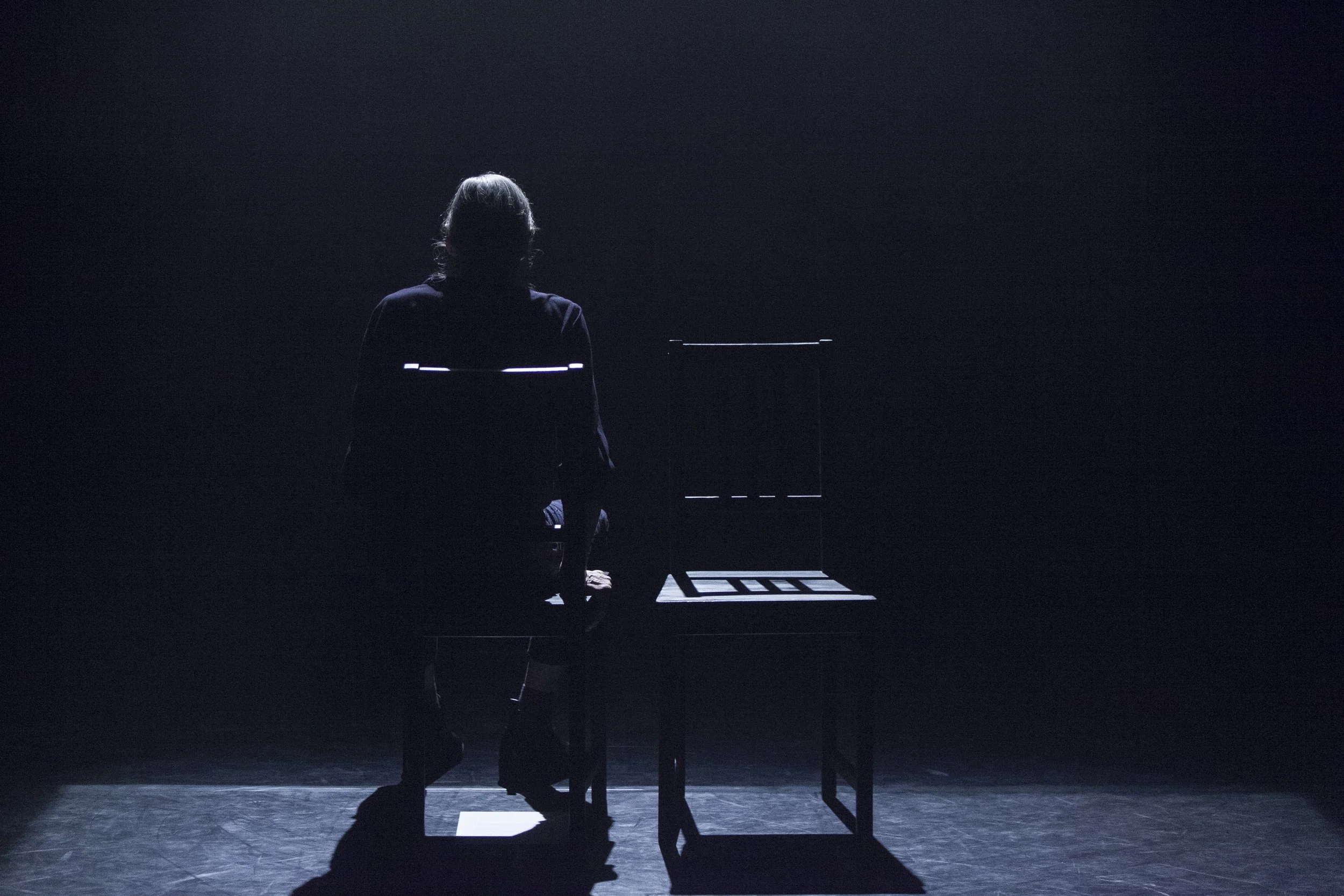
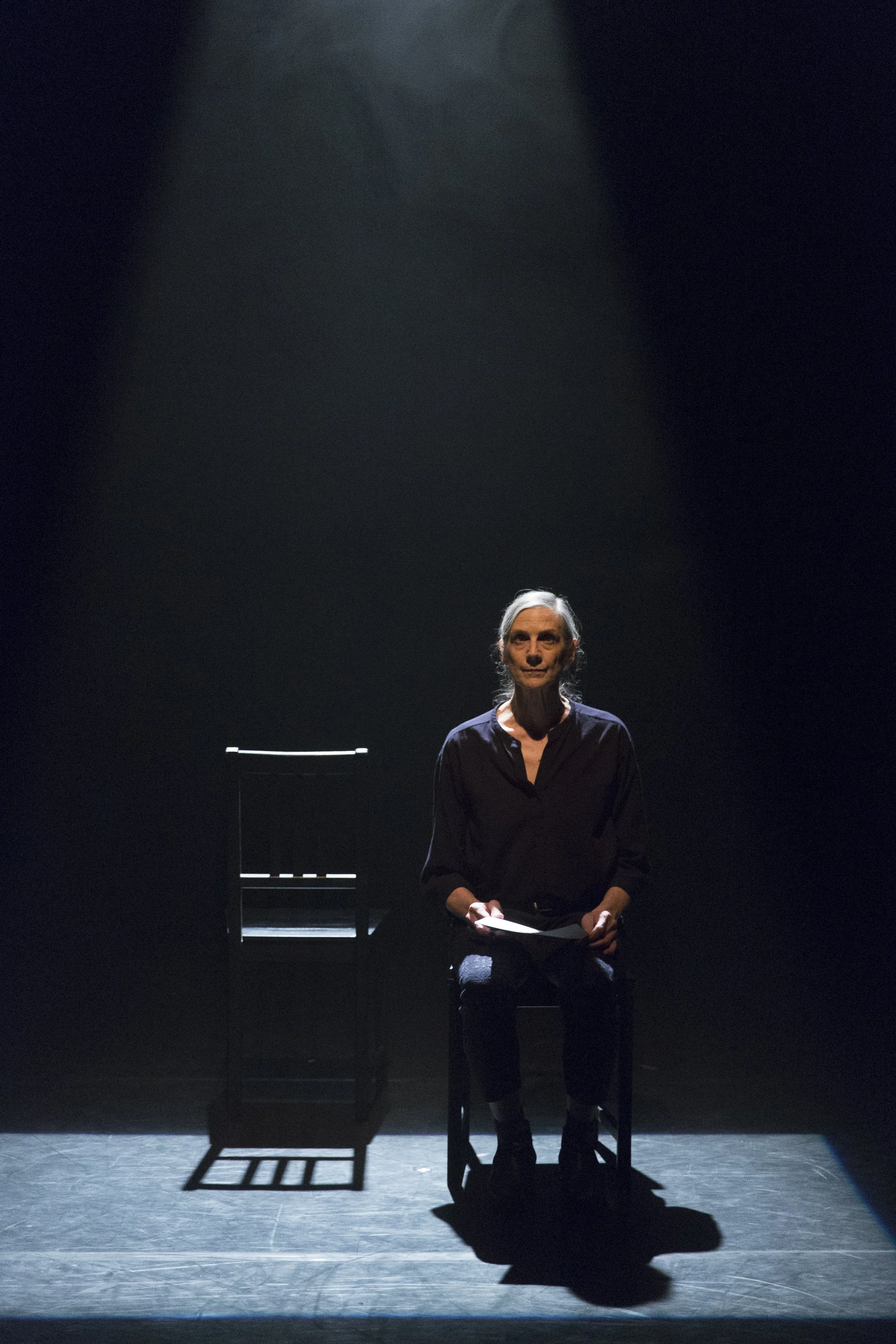
All photos below of Peggy Baker by Aleksandar Antonijevic.
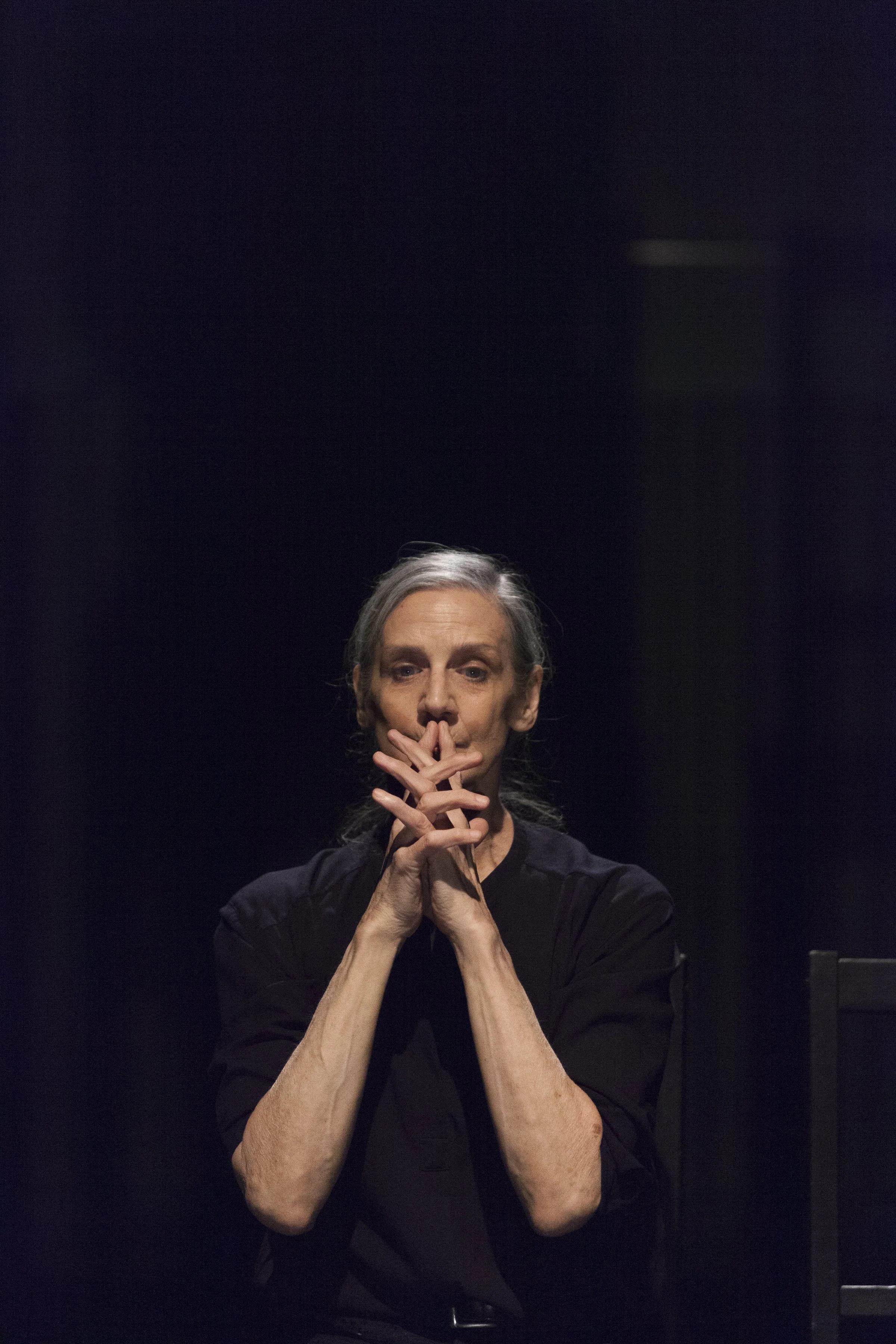

Aleatoric Solo No. 2 (2016)
This week we reach the final piece in Peggy’s Aleatoric series, instigated way back in 2010 with the original Aleatoria installation created for Nuit Blanche. Peggy writes about this final work in the series:
In 2015, I made an unforgettable trip to Japan with the dancer Sahara Morimoto, who was at that time the Artistic Associate with my company. We had been invited by Helen Price to teach a week-long workshop for the Yokohama Ballet Academy, and we made it the centrepiece of a 3-week adventure that began in Kyoto and finished in Tokyo. At the Yokohama Museum of Art, we saw a spectacular retrospective exhibition of work by Takashi Ishida, and I was especially struck by a massive canvas that stood tipped up on its corner in the centre of a gallery. This canvas had been painted on over and over again in successive iterations. It had been gashed. It had light projecting onto it. It was an object, and an artifact of its making. It also presented an environment into which one entered. It was a performance.
The memory of my encounter with Ishida’s installation continued to work on me, and at some point I imagined the blank canvas with which he had begun. I thought about myself beginning a new work and my sense that I can never begin with a blank slate, an empty canvas, a tabula rasa. Rather, I have a sense that my fallibility, my flaws and inadequacies, the complexities of my history as both a person and an artist, mean that the “canvas” upon which I am working is already marred, marked, damaged. And so I took this idea of a “damaged canvas” as the central metaphor for my final aleatoric dance, a solo for the magnificent Kate Holden.
With a huge unpainted canvas ripped open with a long slash and tipped on its corner centre stage, Kate inhabited a world of light and shadow, transparency and opacity, within which she embodied prowess, vulnerability, fear, elation, fatigue, angst, and courage.
Her heroic solo – hugely demanding physically and vocally – closed the four-part program Phase Space. Composing each of those works was deeply fascinating for me as a choreographer, but my ambition with them was to create dances that possessed striking and unique identities that transcended the methods, mechanics, and mysteries of making them. The iconic American choreographer Merce Cunningham spoke eloquently on this point in relation to his own work: “Even with all this preparation, however complex it is, if it doesn’t become dance, then it’s meaningless.”
The concert in which this work featured, Phase Space, was honoured with a Dora Mavor Moore Award for Outstanding Sound Design for John Kameel Farah and Fides Krucker.


Aleatoric Trio No. 1 (2016)
Preparing for a concert in 2016 she titled Phase Space, Peggy created the first (and only) trio in her Aleatoric series. She writes:
I remained fascinated by the richness of developing dances as part of the aleatoric series (in which I had the dancers call up remembered movements from past works and then explored their potency within a new choreographic framework), and during the research for locus plot I encountered the concept of “phase space” which provided a powerful and stimulating new model for working in this way.
In physics, “phase space” is a term used to describe a disruption of time and space in which the laws of dimensional continuity and evenly paced, sequential time no longer hold true. Phase space can be transformed like working bread dough by stretching, flattening, folding, rolling, punching, and shaping so that the original relationship between any two points in time and space shift in radical and unpredictable ways.
I think of memory as functioning along the same lines as phase space. Certainly, it is a realm that exists outside of the usual conventions of spatial boundaries and linear sequencing. Memory unravels, floats, dissolves, reverses, contracts, expands, and spirals. In my experience, memory has more in common with dreams, fantasy, poetry, music, literature, and painting, than with the chronological experience we expect it to capture. A memory can languish in the constant flux of reinterpretation or become a narrative so polished it takes on the shining luster of a brittle shell.
Working with Ric Brown, Sarah Fregeau, and Sahara Morimoto, I reconfigured the movement vocabulary they each brought forward as memories through the use of compositional structures, textures, energies, and themes that I pursued; by disrupting the space with a group of chairs (including two that were child sized) plundered from The Transparent Recital; by the integration of a demanding and far-ranging vocal score by Fides Krucker; and finally by situating musician John Kameel Farah on a ledge about 12 feet up on the back wall of the stage where he could look down to improvise an electronic score according to an open and spontaneous reading of his bird’s eye view of the performance.
Together, these contributions seeded a dreamscape unfolding within a shifting landscape of chairs, and revealing impulses, images, and oblique storylines that emerged from beneath the surface of the steps, amplified by voice, light and electronic sound. Reminiscing about this trio six years later, Sarah Fregeau said, “I loved that piece. All those chairs that were growled at and sung to.”
Aleatoric Trio No. 1 premiered as the opening work in a four-part program titled Phase Space, that also included Aleatoric Solo No. 1 for Sahara Morimoto, Aleatoric Duet No. 2 for Andrea Nann and Sean Ling, and the brand new Aleatoric Solo No. 2 for Kate Holden.


Aleatoric Solo No. 1 (2013)
Building on the creation methodology she first used in Aleatoria (2010) and then again in Aleatoric Duet No. 1 (2012), Peggy embarked on a new solo with her company’s Artistic Associate and dancer, Sahara Morimoto. Peggy writes:
The excitement of mining the movement vocabulary from my growing body of work, of allowing that material to evolve outside the framework of the choreographic context for which it was initially developed, and of focusing on new compositional forms continued to inspire me as I expanded the company’s repertoire of aleatoric dances.
Of the dancers in my group, Sahara Morimoto had by far the greatest breadth of experience within the repertoire, so working on an aleatoric solo for her offered a huge amount of source material. I invited to Sahara to choose freely from among the many dances she had inhabited, and within a just a few rehearsals we had an abundance of movement to work with. Jumping off from the double rectangles that Simon Rossiter had suggested for the duet with Nova Bhattacharya, I asked lighting designer Marc Parent to propose a frame for Sahara’s solo and he offered an elongated diamond – shallow, but wide – defined by a highly reflective mylar frame about a foot wide.
The solo began with the curtain opening on a stage being set up for the dance with improvising musician John Kameel Farah doing a sound check at a tech table on stage left, Sahara warming up in the middle of the stage, and the crew unrolling and taping down the mylar strips. Once the mylar frame was complete and the crew had exited, the first lighting cue came up and Sahara and John went directly into the performance. The detail, physical prowess, and dynamic variation of Sahara’s dancing was phenomenal. The short black shift she wore had a beaded mesh back that glinted and glittered in light reflected off the mylar frame. Sahara’s arms and legs etched the space calligraphically and the potency and gravitas of her persona elevated every moment of the choreography. PB
Discover Peggy’s impetus for her series of aleatoric works by checking out Guelph-based artist Ben Grossman and his double CD recording, Aleatoric Duets for Electro-Acoustic Hurdy Gurdy.

Photo of Sahara Morimoto by John Lauener.

earthling (2009)
This week we’re looking at a work that was created for Vancouver’s legendary Dances for a Small Stage series, curated by Day Helesic and Julie-anne Saroyan. Peggy made this solo on and for herself, mining what would become a rich vien of movement invention inspired by a gift from Montreal visual artist, Sylvia Safdie.
Peggy writes: Throughout the 1980s I made regular visits to Montreal to teach classes and lead intensive workshops at Les Ateliers de Danse Moderne de Montreal, an ambitious training program established by Linda Rabin – one of the most influential teachers in my own life – and Candice Loubert. While I was in town, Linda always made a point of taking me to the studio of her great friend, the visual artist Sylvia Safdie, so that I could see Sylvia’s latest work and hear about the preoccupations that were driving it. Over the course of more than 20 years I was privileged with a rare view of the arc of Sylvia’s work. On a visit in 2007, Sylvia showed me a series of films of she’d recently done and shocked me completely by offering one of these to me as a possible premise for a dance. The film was a close-up of a beetle on its back, in its death throes. Sylvia had worked choreographically with the footage, slowing it down, creating repeated loops and reversals of action. I found the film both sorrowful and exquisite. I had no idea how I might approach it, but I accepted her gift in all humility.
That same year I happened to made a trip to Dia Beacon, where I encountered – among a multitude of deeply affecting works – a series of large plywood “boxes” by Donald Judd. These objects were cubes, closed on all sides, but with the top set part way down into the interior, tipped in one direction and tilted in the other, and with the complex angles of each edge perfectly fitted into the sides. Looking down into the box I felt as though I was looking at a maquette of a stage gone wildly awry and with the proscenium providing a view from above rather than from the front.
I had images from Sylvia’s beetle and Donald Judd’s boxes rattling around in my head when I got an invitation from Day Helesic and Julie-anne Saroyan to present a work for Dances for a Small Stage in Vancouver. The venue was a Legion Hall on Commercial Drive with a stage that was truly and remarkably small. Riffing on Judd’s boxes, I immediately thought of this as the perfect opportunity to install a tilted and tipped floor that would fill the entire stage. Putting myself down onto this surface without ever getting up on my feet created the illusion that the audience was looking down on me, and this possibility sparked the idea of working with movement ideas related to Sylvia’s beetle.
Larry Hahn created a fantastic floor for me, supported by a substructure of struts, and I painted the surface in a way that I thought suited the world of the struggling creature that I had stranded on its surface.
Everything alive on earth is caught up in the cycle of birth and growth and death that is also a source of renewal and transformation. PB
To explore Sylvia Safdie’s most recent exhibition As I Walk, visit YouTube here.
Watch Peggy’s 2020 short, Influences and Intersections - Donal Judd and Sylvia Safdie to discover more about earthing.


Dreaming Awake (2008)
In this week’s post, we look back at the third collaborative project with NY-based dancer and choreographer, Molissa Fenley.
Peggy writes: I was extremely excited to be working with Molissa Fenley again when we set out on the development of Dreaming Awake with a premiere expected early in 2007. I had always taken a huge amount of pleasure in the circuitous choreographic pathways of her dances and the ways in which she connects with musical landmarks, with the dancer navigating the architecture of the sound rather than the phrasing of beats. Dance adrift on an ocean of music.
For Dreaming Awake Molissa had chosen a piano work of the same name by Phillip Glass and used the music – which cycles in repeating loops – twice in a row. It was an interesting coincidence because I had chosen to do the very same thing the previous year with Karen Tanaka’s score for Krishna’s Mouth and I fully appreciated Mo’s desire to double it up.
Choreographically, Molissa set out a series of complicated phrases in what proved to be a first iteration, because before long the phrases were fragmented and rearranged many times over, sometimes doubling back to places on the stage and within the choreographic language that were maddeningly familiar. It felt something like being inside of an architectural construct by Escher and it was quite disorienting. In an early studio showing I became hopelessly lost when I discovered myself at the same intersection in the dance several times in a row, an experience I found completely unnerving.
While I was rehearsing Dreaming Awake I developed chronic pain in the third metatarsal of my right foot. It eventually proved to be a stress fracture, and I learned that it wasn’t going to get better unless I could stop altogether for many weeks. On the other hand, it had been hurting me for months without interfering with what I needed to accomplish, so I decided to go ahead with my planned 5-city tour (titled “3”) thinking that once it was finished I would take time off. Then, just days before leaving for Montreal, doing a simple transfer of weight to my right foot – (you’ve probably seen this coming) – I felt the bone snap and there was no longer any question about when I would stop so that the healing could begin.
Embarking on tour a year later, my foot was up to the physical challenge, but the complexities of finding my way through the labyrinth of steps in this gorgeous dance continued to threaten me with catastrophe. I finally premiered Dreaming Awake in Calgary, but that foot injury marked the beginning of slow shift in my thinking and eventually in my dance practice, one that led me to the role of choreographer of ensemble works.


Krishna’s Mouth (2006)
Having first worked together in 1999 on Words Fail, and then in 2003 on The Transparent Recital, Peggy Baker and cellist Shauna Rolston team up for a third collaboration called Krishna’s Mouth in 2006.
Peggy writes: For an outdoor performance in the Toronto Music Garden on Queen’s Quay West Shauna and I performed a version of The Transparent Recital tailored to the setting, and to complete the program I asked her to open with a work that she would perform without me. Shauna chose Songs of Songs, a gorgeous work for cello and tape by Japanese/American composer Karen Tanaka. I instantly fell in love with this score, its slow spirals of melody tenuously interlacing and then floating apart on the currents of the underlying drone, and with crystalline bells piercing the undulating surface of the sound.
I reached out to Ms. Tanaka immediately to explore the possibility of choreographing a solo to this piece and when it turned out that no recording existed that I might work with she allowed me to arrange a recording session with Shauna. I took the recording with me to Circuit-est in Montreal where a teaching residency included studio time for my own creative work. I have vivid memories of the sound resonating in the spare studio and of the strong pull of the music into an unexpected narrative sphere.
I had been pouring over Annie Dillard’s For the Time Being, a book in which she brings together myths and stories from across epochs and cultures as a way of contemplating how one might come to terms with the underlying existential sorrow of human life. At the time, I had just made the huge and dismantling shift from being my husband’s primary caregiver (he lived with a particularly aggressive and chronic form of multiple sclerosis) to his living in long-term care, and the sadness and guilt attached to this situation was tremendous. One story in Dillard’s book struck a particularly deep and resounding chord for me. It is a story about Lord Krishna as a baby. He’s with his mother, in a garden, and he’s crawling on the ground. He grabs a clod of earth and puts it in his mouth. His mother slaps his hand away, and when she reaches in to clean out the dirt, she sees the entire universe in his mouth. As a caregiver to my husband, I had felt as though he needed me to guide him and keep him safe, but this story turned that idea on its head and proposed him as my teacher, which he surely and far more truly was.
In dancing this work I speak this story out loud, many times. I understand that this story is not mine to tell. But it is a story that I needed to hear, a story that somehow found its way to me, and a story that lives in my body.


The Disappearance of Right and Left (2004)
This week’s work is a truly landmark piece in Peggy’s repertoire. A dancestory created with Sarah Chase, The Disappearance of Right and Left artfully shares stories from Peggy’s family history in a deeply compelling work that speaks to audiences across genres and generations.
Peggy writes: Sarah Chase is a superb artist whose body of work stands as an utterly unique and hugely valuable contribution to the art form. Sarah frames memoir within choreographic structures, combining text and movement in ways that allow the inner life and personal history of the performer to be drawn into alignment with the life experience and empathetic capacities of the audience witnessing the work.
I’m thinking that my own dance with spoken text (a true story, 1997) was made the same year that Sarah created her first dancestory, Muzz. Sarah’s dance was much longer and more complex structurally, but the biggest difference was that Sarah spoke in the first person – unabashedly using the identifier “I” – whereas I spoke in the third person, veiling my relationship to the events I described through the use of the descriptor “the woman”. A studio showing of Muzz by Sarah at Damn Straight on Spadina Avenue in Toronto remains an indelible memory and the power of the work, and of her performance, was absolutely the inspiration for approaching her with the idea of commissioning a work in this style for me.
Six months prior to going into the studio, Sarah assigned me the task of writing two stories representing each year of my life. 51 years old at the time, I needed to excavate 102 stories from my life. Conversations with my parents about my childhood also brought forward stories from their own lives and in the end, Sarah included stories that spanned five generations in my family.
The Disappearance of Right and Left emerged as a work of 45 minutes that was both terrifying and cathartic to perform. It revealed deep connections of experience and learning across the history of my family and allowed me to come to terms with some of the most dismantling turning points in my own life.
Sarah possesses the extraordinary ability to compose and direct performance works centered on personal history without ever veering into the trite or sentimental. Dancestories made for herself, for Marc Boivin, Andrea Nann, and a second work made for me in 2018, (unmoored), comprise a truly remarkable collection of works. PB
Sarah adds this: Peggy was a pivotal teacher, mentor and guide in my life, and I was thrilled and awed to be creating with her in 2004.
I loved how Peggy spoke when she taught, the vivid way she had with language, the colour of joy in her voice, and her inimitable gestures. I knew I wanted to make a work that would allow Peggy to speak stories from her life, to share her rich inner world, and to magnify her extraordinary gestures into a danced language. I wanted to understand her biography and how it had shaped the artist I loved, and if possible to reveal this to an audience.
These 102 stories/memories she assembled sparked deep conversation between us. I remember feeling overwhelmed by the many possible performance directions the material could take. (The first rehearsal we shared for a small audience was over an hour and a half long!) We ended up focussing on 12 stories that were moments when she or a member of her family, experienced a deep shift in perception, which we captured in the title.
To me, Peggy’s dancing contained the big dome of the high prairie skies around Edmonton where she grew up; the open geography of her childhood called forth in her long expressive arms and hands. So part of the beginning of the rehearsal process was creating a dance based on images and experience of being in that landscape. I wanted this to be the ground for the emotional stories that she would be sharing during the piece.
Peggy and I poured over photographs that represented the 12 essential stories we finally chose. In the first performed versions there was a large backdrop that had these double-sided images on it. They swivelled to reveal a full prairie landscape that was on the reverse of the 12 individual story images. I realised, eventually, that the backdrop was actually limiting the performances. Peggy’s gestures were conjuring so deeply the worlds of the stories, that having a literal photographic illustration behind her was an unnecessary distraction. We stopped using the backdrop.
This process was an incredible journey into Peggy’s inner life. It deeply changed the way I thought about creating, and continues to inform my work to this day. SC
“Disappearance is autobiographical…Chase makes full use of Baker’s wonderfully eloquent arms that carve the air in generous sweeping motions or settle momentarily into a detailed sculptural pose.” Michael Crabb , The National Post
The Disappearance of Right and Left is one of the few works in Peggy’s repertoire danced to music with lyrics. For a deep dive on Joni Mitchell’s classic song Amelia, selected by Peggy to feature in this show, visit jonimitchell.com


Unfold (2000)
In 2000, the decade-long collaboration between Peggy Baker and Andrew Burashko sees them tackle a major new work suggested by Andrew: Aleksandr Scriabin’s 24 Preludes, Op. 11. Peggy writes:
“Andrew had been proposing this work for some time, and the gift of commissioning funds from Symphony Space in New York and the National Arts Centre in Ottawa – with performance dates that fell just a month apart – provided the perfect opportunity for us to dedicate ourselves to the development of this demanding work.
Like Chopin’s 24 Preludes, Op. 28, (which served as his model), Scriabin composed a short work in each of the major and minor keys of classical western music, and despite this academic premise, his 24 pieces are charged with deep emotion. Some sound as though they are at a loss to complete themselves, while others give the impression that they are about to float apart, combust, collapse inward, or dissolve. A couple of them are as conclusive as a slammed door at the end of a heated argument. Taken as a group they propose what I can only describe as a self-portrait of the composer, and any pianist taking them on must transcend their highly personal specificity and bring a singular interpretation to the score.
I wanted to step up to the score on these same terms, discovering within the style and scope of the music a framework within which to reveal myself with immediacy and authenticity. Ultimately, Unfold offered the audience an intimate experience of Andrew and I as individual artists and as artistic collaborators, but also simply as very different people who have built a deep friendship by bringing our worlds together.
Unfold falls half-way through the 20-year arc of my shared performance life with pianist Andrew Burashko and looking back I see that this was the last of my choreographic works to be created with him; the new dances that followed for he and I were the work of others – Doug Varone, James Kudelka, and Molissa Fenley.” PB
“Baker’s angular, constructivist choreography seems a part of the music, another instrument playing the melancholy themes. Sometimes she dances in silence… Sometimes Burashko plays alone. In those passages the ghost of the music and the after-images of Baker’s movement are ever-present.” - Susan Walker, The Toronto Star
If you’re looking for any information on Aleksandr Scriabin, the Scriabin Association has you covered and then some.


loin, très loin (2000)
We’ve reached the next - and largest - collaboration between Paul-André Fortier and Peggy Baker, an epic full-evening solo entitled loin, très loin which translates to far, very far. And that’s exactly where Paul-André took both Peggy and the audience for this work, to a place none of us had previously known existed…
“For several months at a time, during 1998 and 1999, I had the huge privilege and grand adventure of being included in quartet project with Fortier Danse Création in Montreal, La part des anges. The title, (which translates as “the angels’ share”), is a French idiom that refers to the small portion of alcohol lost through the wooden walls of barrels used for fermentation. Perhaps this title was a reference not only to what might be lost in translation, but also to what essence might be captured by bringing together four dancers whose foundation in the dance was dramatically different in each case. In his program note for this work, Paul-André describes me as coming from the world of modern dance; Gioconda Barbuto as being a classical dancer; and Robert Meilleur as a proponent of contemporary dance. I certainly took my own portion during this exceedingly rich and deep experience, and it has continued to work on me over the intervening decades.
Paul-André entered into creation by having each of us learn a recent solo of his, Novembre, and once we all landed with him through this dance he set out through far ranging choreographic experimentation to allow the quartet to arise. His point of view on this was that the dance was waiting in our bodies and in the space and that it would reveal itself through the tasks, proposals, and provocations he set forward. We worked in silence and through a broad range of “atmospheres “ in the studio. Some days were charged with the rigour of copying or improvising, some rode on exuberant joy and hilarity, others were austere and saturated with the weight of significant gestures and choreographic interactions. We worked as a quartet, as re-coupling couples, as soloists. For scenes in which all of us did not dance, the others stood in an upstage centre antechamber as witnesses.
It was thrilling to be on stage with great dance artists in this superb work in Vancouver, Edmonton, Toronto, and Montreal. A year later, Paul-André brought us back together, (with the stellar Lisa Kovacs rather than Gioconda, who was now a dancer with NDT3) and we remounted the dance during a 3-week residency in Angers, France followed by performances in Bordeaux. One night, returning to the hotel from the theatre, Paul-André and I improvised together as we crossed a bridge, and it suddenly hit me very hard how much I was going to miss being a part of his work and world. The next day I gathered up my courage and asked Paul-André if he would consider allowing me to perform a program made up of his short works – Non Coupable, Novembre (which had struck a deep chord in me), my duet from La parts des anges with Robert Meilleur, plus something new for me. When Paul-André’s eyes widened and he said quite simply “Non”, I felt the terrible thud of refusal, and the humiliation of having stupidly trespassed beyond the scope of our relationship. And then he immediately said, “I prefer to make you a full-evening solo”. Within a year, he had done just that.
I wrote a program note for this dance that has become more fully realized with each passing year:
I have become a very different dancer, even in some way a reinvented woman, by virtue of being set in motion by Paul-André Fortier. It is as if his dance asks, “What if this had been the case? Would you not now have become someone else?” So embodying a rewritten history, I navigate a new fate.” PB
Paul André adds: “This piece was created extremely quickly. In fact Peggy struggled to remember all the material I was creating, so swiftly did the ideas come tumbling out. The choreography, costuming, lighting and the music all worked in tandem, feeding Peggy’s interpretation. It was the most demanding solo Peggy had ever performed. The multitude of performances at Montreal’s Agora de la danse seemed as daunting as climbing Mount Everest. And what a magnificent ascent!”
“It would be impossible to overstate the gravitas of this work… The revolutionary ethos of Fortier’s own early years…are summoned forth here by the acid guitar solos of Gaetan Lebœuf’s original score.” Michael Scott / The Vancouver Sun
Watch a short film made about Paul-André Fortier, released by the National Film Board here on the occasion of the 2012 Governor-General’s Award for Lifetime Achievement in the Arts.
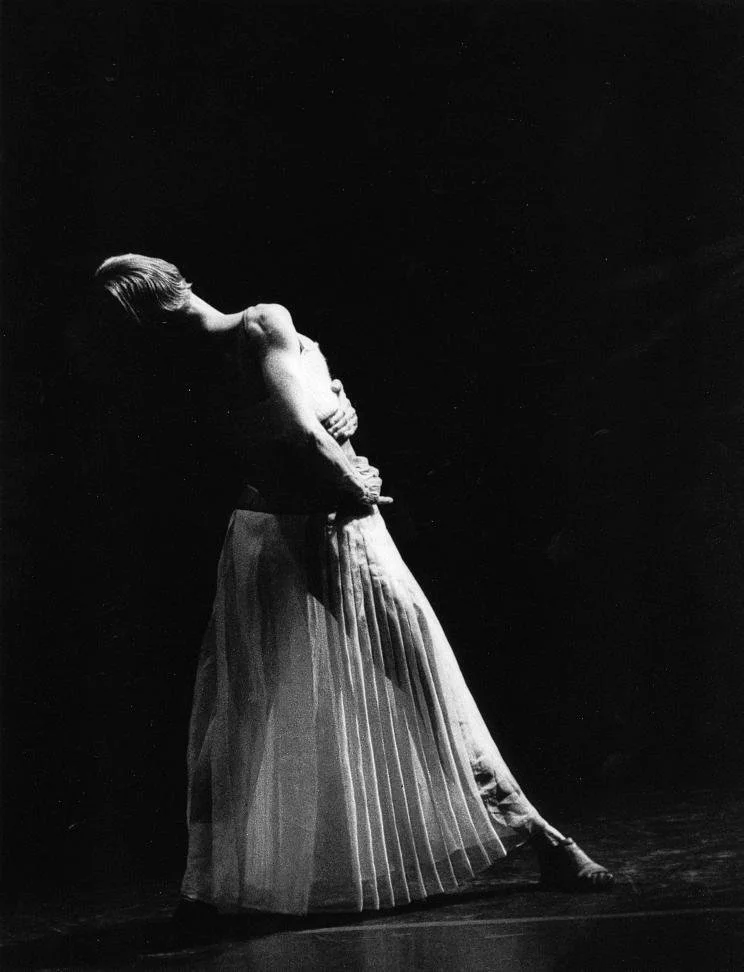
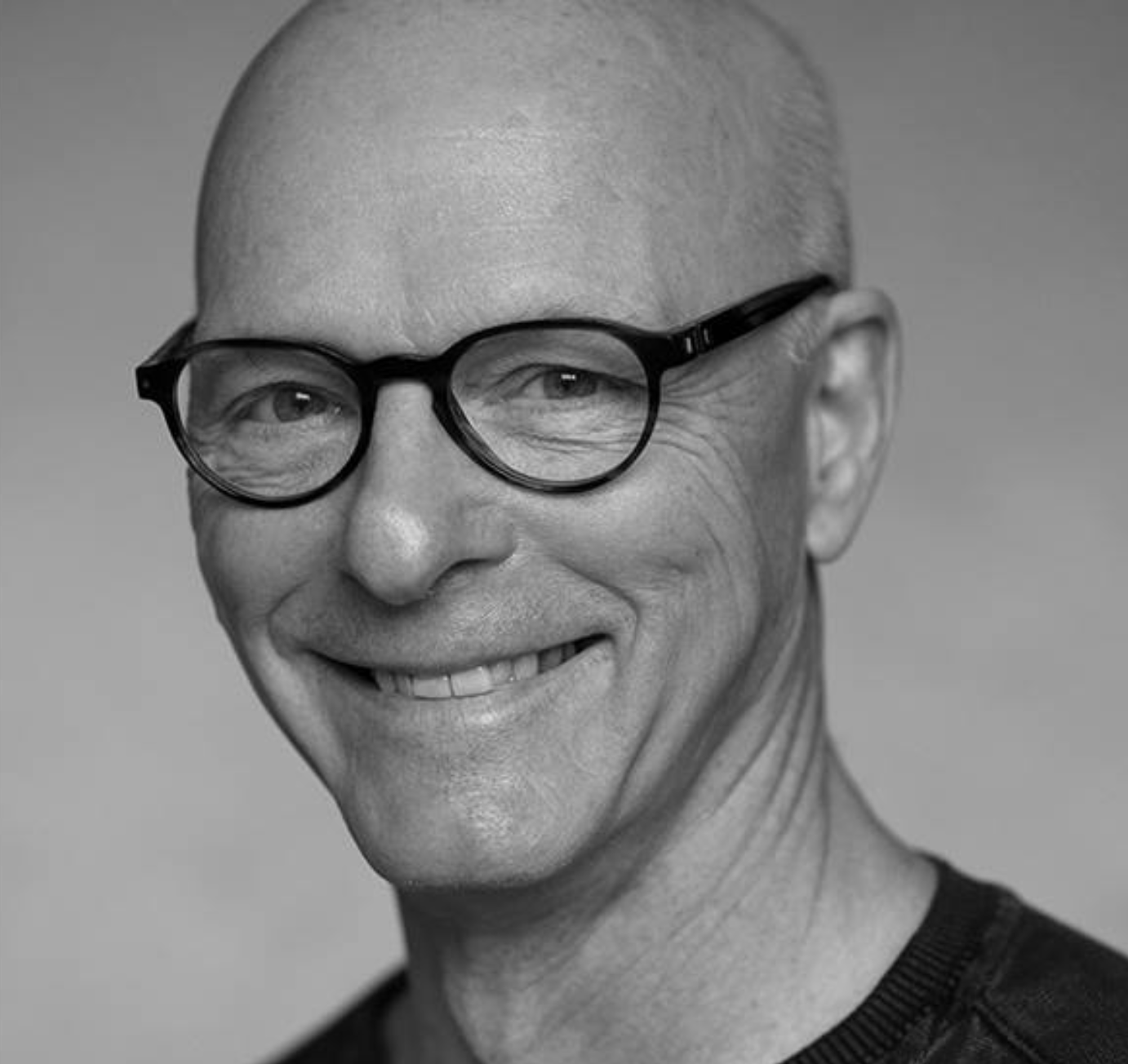
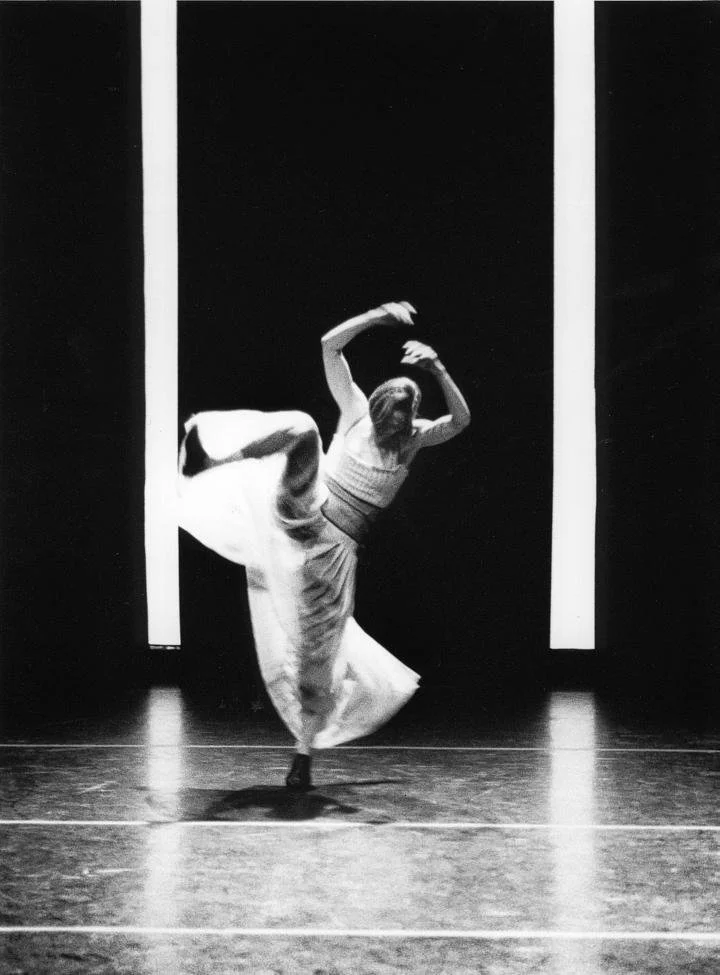
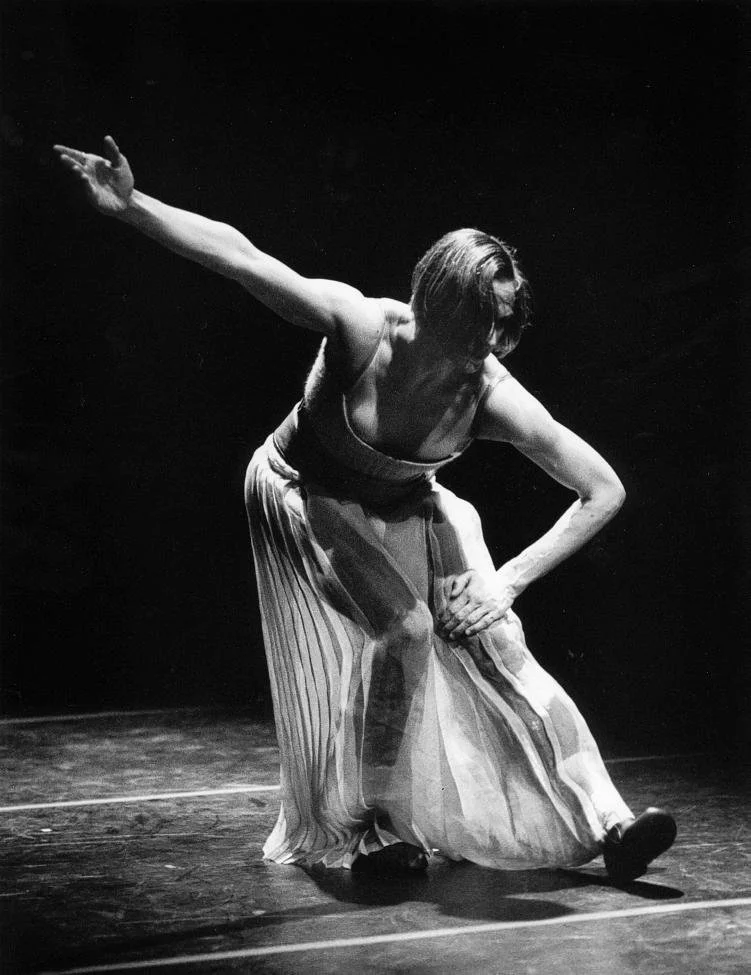
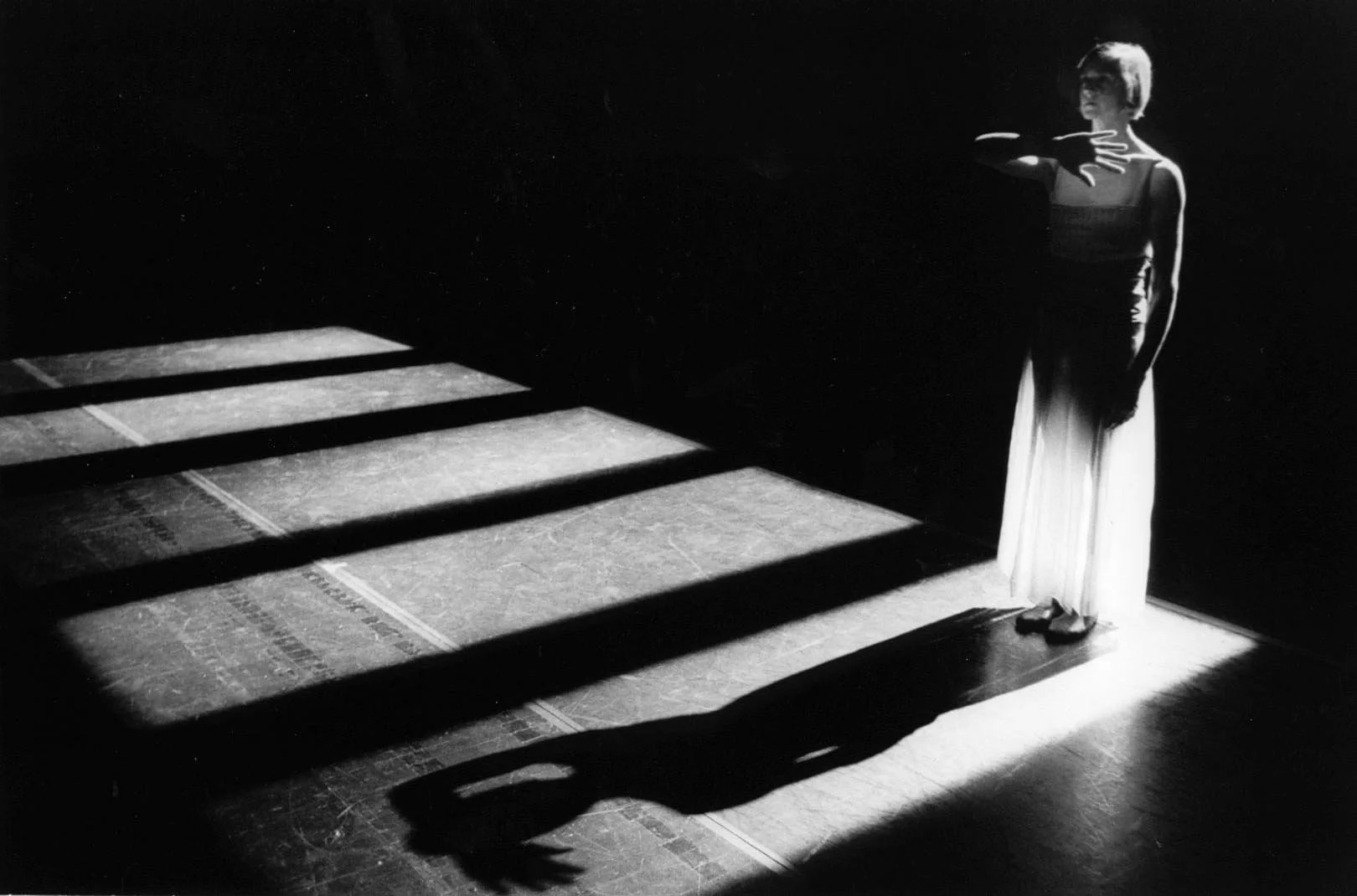
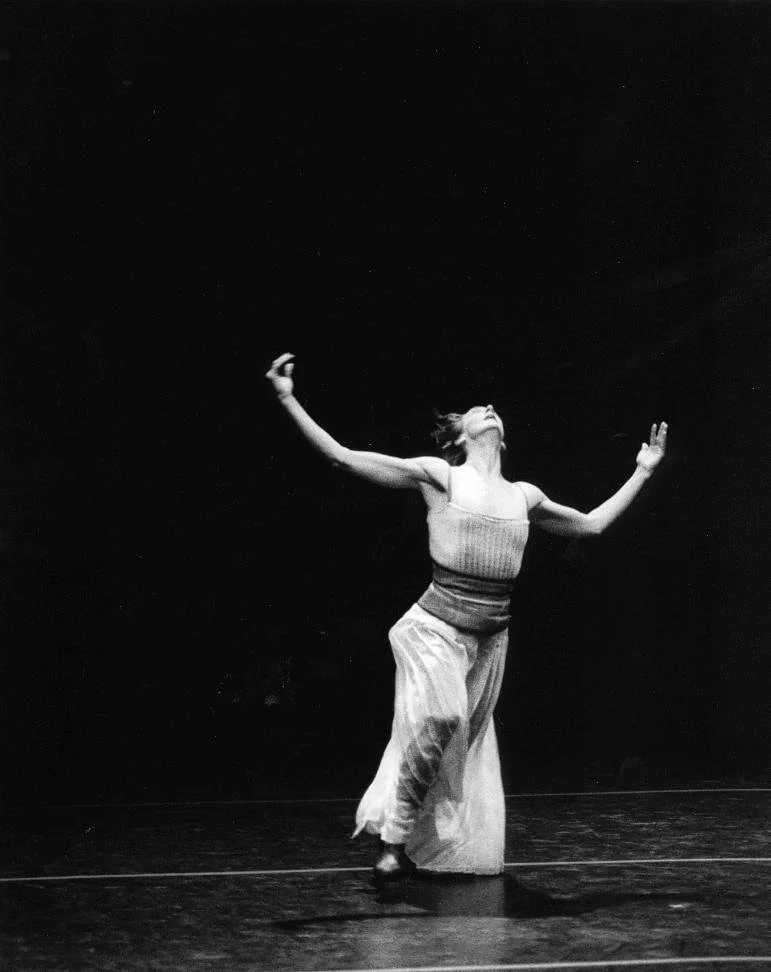
One of the most daunting challenges I have encountered in my dance life was an hour-long solo, loin, trés loin, created for me by Paul-André Fortier. It went absolutely against the grain of my technique and physicality. I couldn’t tell without the feedback of the rehearsal director, Ginelle Chagnon, whether I was inside or outside the aesthetic. The dancing was grueling to the point that I could barely get through it, and it left me thoroughly battered and spent. This was a solo made expressly for me, and I was terrified that I would humiliate myself as a performer and fail Paul-André as a creator. But some extraordinary things can happen when we are thrown beyond the outer reaches of our comfort zone and we are required to embody a physicality far removed from the self-image we like to affirm. Our strengths and weaknesses are laid bare; we are forced to deal with things we’d rather avoid; we see, and are seen, through a new lens; everything is at stake, so now there is something of real interest and importance to share. My program note for loin, trés loin was a thank you note to the choreographer for helping me to move beyond myself and toward something higher:
I have become a very different dancer, even in some way a reinvented woman, by virtue of being set in motion by Paul-André Fortier. It is as if his dance asks, “What if this had been the case? Would you not now have become someone else?” So embodying a rewritten history, I navigate a new fate.
As dancers, we are shaped by the works we perform, and that impact goes beyond our professional lives, directly to the personal sphere. As choreographers, we express ourselves on a kinesthetic and aesthetic level, but that expression is a direct translation of our imaginative, experiential, and intellectual lives, our basic humanity.

Cirrus (1997/2000)
A faculty member of The Juilliard School since 1995, Irene Dowd has been a foundational presence in Peggy Baker’s dance life, providing neuromuscular training and creating Cirrus on and for Peggy in 1997. Peggy explains:
“It’s beautiful to think back to this brief and exquisite dance, choreographed by my dear friend and cherished mentor Irene Dowd. Beginning in 1985 – and continuing over the next two decades – Irene guided me in discovering the inner landscape of my body, in all its mystery and magnificence, through an evolving movement practice grounded in functional anatomy.
In 1997 we shifted our focus to a dance choreographed for me by Irene. In a recent exchange of memories around our process, Irene remembers being under the sway of two important paintings by her late husband, Charles Stokes – the dazzling and rhapsodic Perpetua (which he was just completing) and the labyrinthine Inner Temple (which was newly underway).
Irene titled the dance Cirrus, as she felt the definition – “a tendril, a long thread-like organ by which a plant climbs; a light fleecy cloud at a high elevation” – sounded as though it was describing the movement. We had created in silence, but once the work was completed, I suggested dancing it with a John Cage work titled Dream. I didn’t have a chance to perform Cirrus until 2000, when it premiered as part of an evening titled Interior View. Irene allowed me to finish her dance by reaching my hand to the piano on the last note. No photographs of this dance exist, so it remains a treasured memory.” PB
To see an example of Irene’s approach to teaching functional anatomy through choreography, visit her website here.
To learn more about artist Charles Stokes, visit SeattleArtResource here.

Photo of Irene Dowd by Matthew Karas.

Yang (1998/2003)
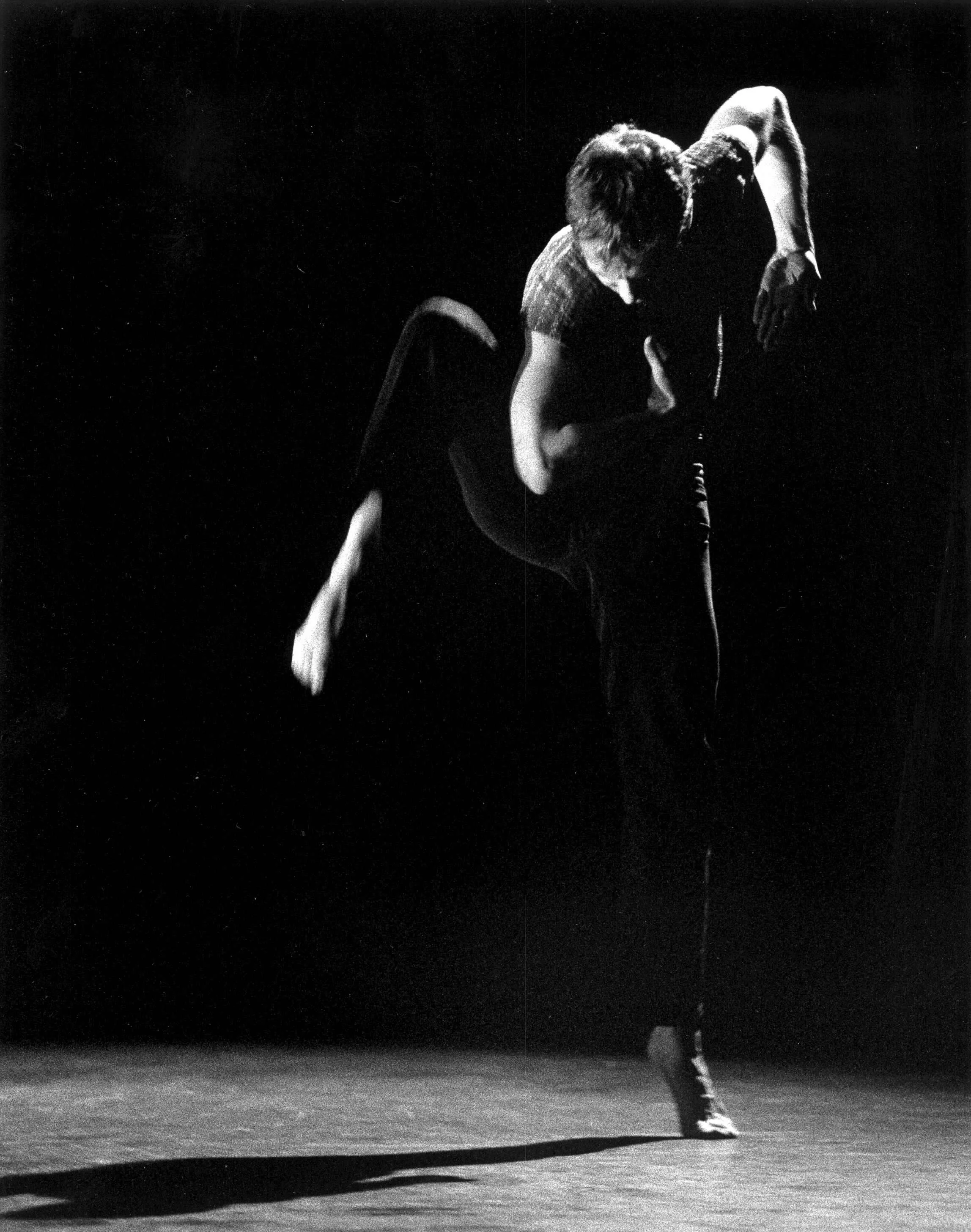
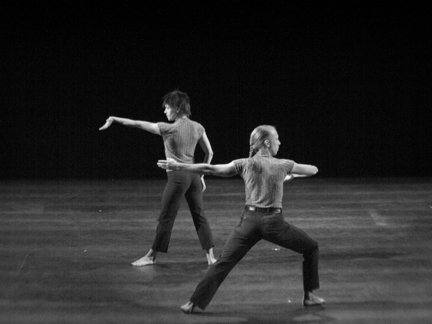
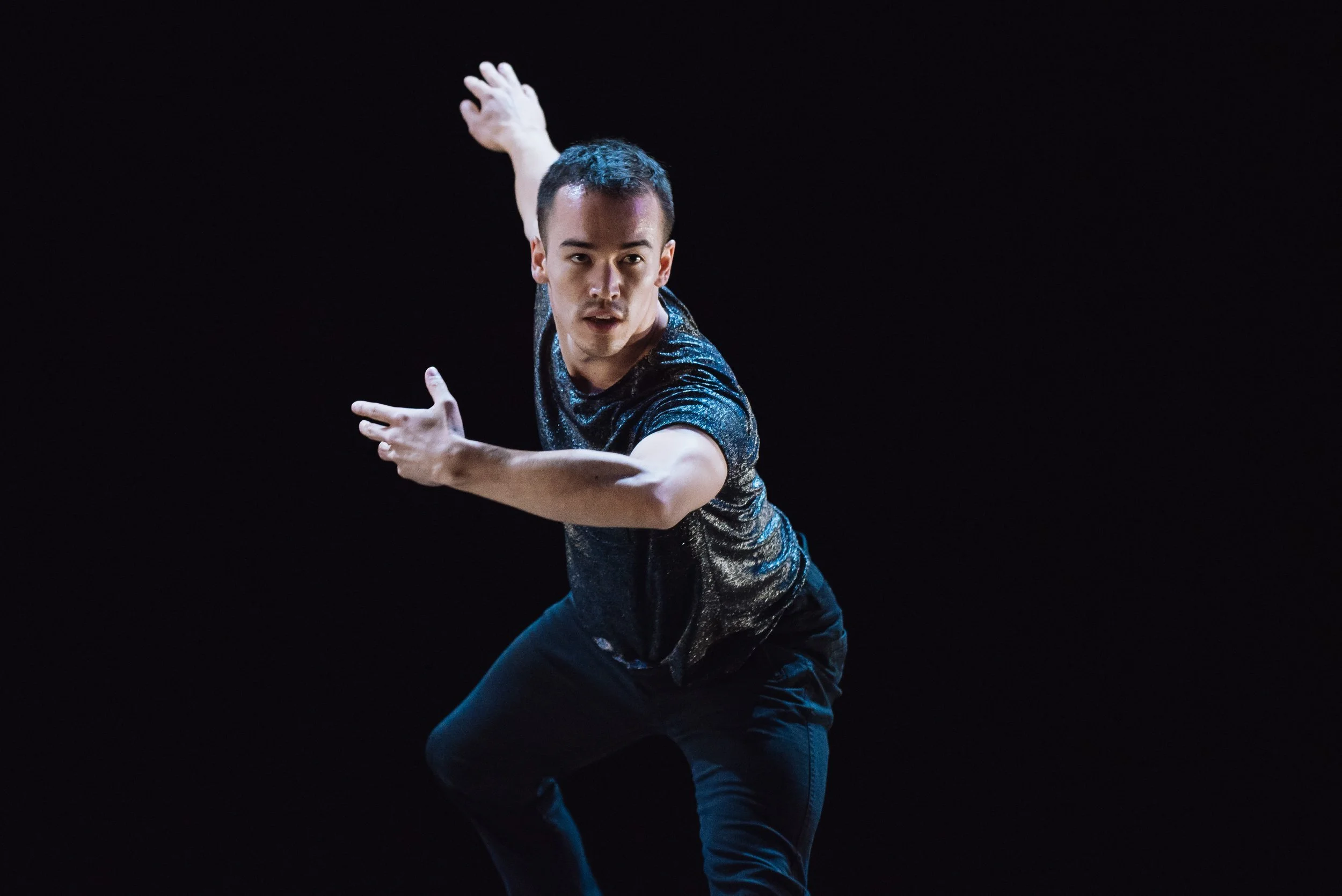
Peggy is occasionally commissioned by other artists to make works for them - including Sarah Chase (Garland, 1996), Dancemakers (for Carolyn Woods, Rocket Girl, 1999), and Nova Bhattacharya (Map of the Known World, 2000). The only commissioned work from Peggy to be bought into the Peggy Baker Dance Projects’ repertoire is Yang, made for Sylvain Brochu in 1998. Sylvain writes:
“In 1997 I was awarded a Canada Council grant to commission solos from 5 selected Canadian choreographers. I had studied with Peggy, seen her perform, and was very inspired by her commitment and artistic integrity. Even though I had never been through a creative process with her I had a strong feeling that our connection would produce a powerful piece. Peggy knew me as a dancer and set up to create a dance that would greatly challenge me technically. I distinctly remember the main creation period: I had flown to Toronto for two weeks. The process was very demanding physically, but I applied myself wholeheartedly, and with a level of trust that I had not often experienced before. Yang turned out to be one of the strongest pieces of my solo repertoire, and was the ideal finale for my solo concert. I’m grateful for the gift of this dance, which lives on through successive generations of dancers.”
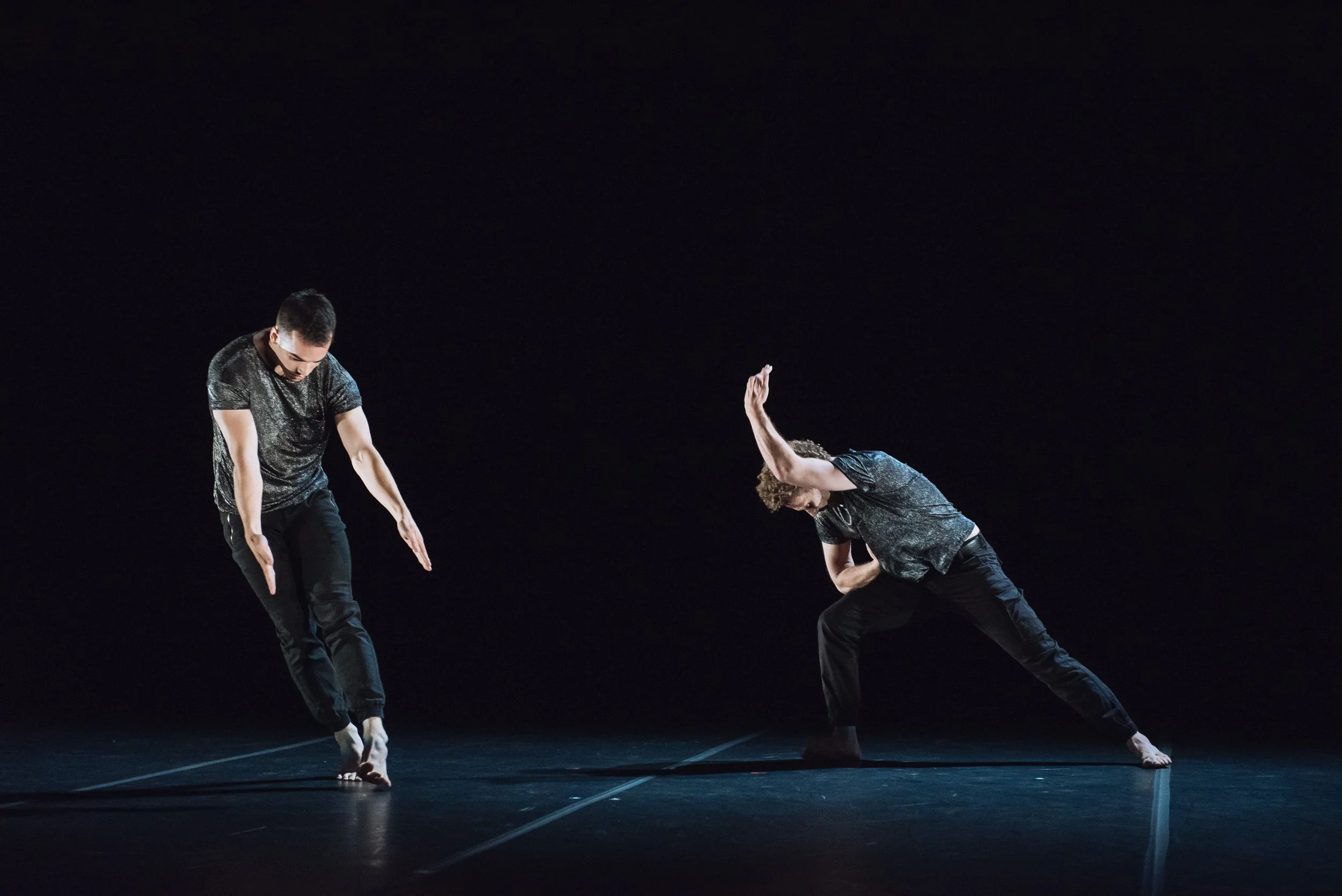
Peggy adds: “Like Sylvain, I still remember the intensity of the creative process for this dance. I went in from day one with the intention of developing an action language that would provide us with a challenging and exciting encounter, as Sylvain and I are dancers with extremely different movement sensibilities. That encounter was quickly informed by the androgyny we each embody. The forceful, strident movement vocabulary we were working with shifted me more into androgyny, and took Sylvain – a dancer whose movement signature is cushy and lush – further away from androgyny. In order to clarify our intentions, we focused on the qualities associated with the Taoist principle of yang, described as bright, hard, masculine, round, odd-numbered and upward moving. In the first phase of our work we developed the movement language, and in the second we arranged that material in relation to a riveting work called Frisking Prolationum for 11 Percussionists by the Belgian composer and filmmaker, Thierry de Mey.
Sylvain premiered Yang at the 1998 Dance in Canada Festival in Ottawa. Five years later, for The Choreographer’s Trust, I developed a duet version for Sylvain with the magnificent Shannon Cooney. This remains one of my favourite dances, and both the solo and duet versions have been staged many times by my company and The School of Toronto Dance Theatre.” PB
If you’re taken with the music of Thierry de Mey, watch this excerpt of a work he created with Anne Teresa De Keersmaeker for Rosas entitled ROSAS DANST ROSAS.

furthermore (1999)
If you’ve been following the blog for a while, you’ll know that by 1999, pianist Andrew Burashko and dancer Peggy Baker had been touring Canada and the USA together for almost a decade. They often included a piano work for Andrew to perform without any dance, and in this week’s blog Peggy recounts how Andrew’s choice of Piano Music No. 2 by John Cage led to the creation of furthermore:
“For this particular composition, Cage had employed the chance procedure of taking flaws in the manuscript paper on which he was notating and assigning them musical notes, some of which would be played on the keyboard, and some by striking or plucking the string directly, reaching inside piano. This piece therefore required that the musician stand at the piano in order to be able to play both the keyboard and the strings simultaneously, while also shifting their weight to extend a leg to work the pedals that sustain or dampen notes. I found the movements required of Andrew quite beautiful, and highly choreographic.
In the fall of 1999 Andrew presented his first recital program for a new music performance initiative under his artistic direction, Art of Time Ensemble. Contemporary music by Americans John Cage, Peter Lieberson, George Crumb, Sebastian Currier ,and George Gershwin was brought together in a program titled Fascinatin’ Rhythms. Along with Andrew, the stellar musicians on the program included Steve Dann (viola), Beverley Johnston (percussion), Barbara Hannigan (soprano), and Joel Quarrington (double bass). I danced to Cage’s Piano Music No. 2, and my choreography was an elaboration on Andrew’s actions so that the work became both a piano solo and a movement duet. I titled the premiere and, moreover, and later renamed it furthermore, though I can no longer imagine why I thought it needed to be changed…” PB
To read more about how John Cage redefined music, visit NPR here.
Art of Time Ensemble has become a live performance juggernaut in Toronto. Andrew’s company presents an annual season of concerts that fuse high art with popular culture. To listen to a selection of their recordings visit Soundcloud here, or their YouTube channel.


One Voice (1997)
Back in 1990, Winnipeg-based choreographer, educator, and dance advocate Stephanie Ballard made a solo on Peggy set to Song from the Thracian Plain sung by the Bulgarian State Television Female Vocal Choir. Part of a larger work of Stephanie’s called Continuum, this untitled solo found new life seven years later.
Stephanie writes: “Peggy Baker is an extraordinary dance artist. A Canadian jewel. Her unique ability to fulfill movement with power and clarity has inspired me since going across the floor with her at the Toronto Dance Theatre studios in 1973. The creative point of departure for this solo for her came from my interest in the Bird Goddess as described by Marija Gimbutus in her book The Language of the Goddess. Peggy was able to embrace the statuesque and spiritual qualities that numerous bird goddess images and stories portrayed. Our creative process embraced primitive and contemporary movement.” SB
Peggy adds: “I always loved this solo from Continuum, and wondered if it would stand on its own without music. I planned to include it on a program for which all of the other music was performed live. Stephanie very generously allowed me to premiere the solo - which we titled One Voice - in silence for musicDANCEarray in March of 1997. I was thrilled by performing the distillation of this work, and danced it on a several different programs over the next few years.” PB
Collaboration. Evolution. Refinement. These are recurring themes in Peggy’s work and process, and this project with Stephanie is a wonderful example.
PS - Stephanie also wrote “I loved Peggy’s idea to perform the work in silence - and it worked!”
"... the dance equivalent of a performance by a legendary singer...her concentrated movements, in silence, invoke a soulful music." Susan Walker, The Toronto Star
To read more about Marija Gimbutus and her book The Language of the Goddess visit The LA Times here.


a true story (1997)
This week’s blog post looks at the first dance story that Peggy created. It foreshadows a deep interest in drama, text, and vocalization that she will explore in the coming years, working with artists such as Sarah Chase, Denise Clarke, Michael Healey, and Fides Krucker.
“An invitation to perform at a fundraiser for the December 6 Fund demanded some deep thinking about how to contribute something relevant as a dancer. The Fund provides interest-free loans to women in the Toronto area working to extricate themselves from violent relationships, and their May 1997 event was titled Reclaiming Mother’s Day: A Critical Celebration of Motherhood.
When Ahmed Hassan and I married in 1990, I joined the household he shared with his 13-year-old daughter, for whom he had sole custody, and so became her stepmother. “Stepmother” – what a loaded word. So harsh and intrusive sounding, so laden with negative connotations. I developed a true story, a text and movement piece that unpacked my struggle with that word and with its eventual replacement by a word coined by the young child of a close friend.
For that first performance, I wore street clothes, including my Blundstones, standing at a microphone on the small stage at Trinity St Paul’s United Church. The program was extremely moving and included a performance by Tafelmusik and spoken contributions by actors Shirley Douglas, Linda Griffiths, and Elizabeth Sheppard; writers Irshad Manji, Susan Swan, and Stevie Cameron; politician Olivia Chow; and comedians Diane Flacks and Sandra Shamas. Diane Flacks followed me on the program and when she approached the mic imitating my walk before turning to me with a huge beaming smile I flushed red and felt my heart race at the thrilling embarrassment.
I found it incredibly potent to speak while dancing, and the piece landed for me with a tremendous resonance. I went on the perform a true story many times over the next 20 years.” PB
“Ms. Baker, a Canadian whose superlative dancing and clever choreography are well known in New York, started off with a true story. Her initial stamps, violent torso rotations and emphatic arm folding seemed like pure dance. Suddenly the gestures were imbued with dramatic meaning and illustrations of words spoken by the dancer.” Anna Kisselgoff, The New York Times
To watch the parentally-themed comedy stylings of Diane Flacks, visit YouTube.com here.


Encoded Revision (1997)
By 1996 Peggy and pianist Andrew Burashko had a repertoire that included 19th century western music by Brahms, Chopin and Liszt, early 20th century music by Tcherepnin, mid century compositions by Prokofiev and Cage, and one late 20th century new music work by American composer Peter Garland. What would be their next focus? Peggy fills us in:
“When I opened a conversation on commissioning a new work, Andrew immediately suggested Michael J. Baker who was extremely active in the Toronto music scene as a composer, conductor, and multi-instrumentalist and had been composing for dance since the early 1970s. We quickly agreed on Michael (whose last name I share because we had been married for 12 years of our young adult lives) and were ecstatic when my newly incorporated company, now called Peggy Baker Dance Projects, secured our first ever grant to commission the music.
The score for Encoded Revision requires a performance of post-modern virtuosity by the pianist who is constantly shifting metre and tempo, has text to deliver throughout and is also called upon to manipulate the score pages as props within the choreography. I loved performing this dance, but the choreography did not meet its potential until it was revived with Benjamin Kamino 16 years after its premiere.
The program notes give a full overview of the form and content of the piece:
The creation of this work was based on the literary form of the palimpsest: a document written upon several times, with remnants of earlier, imperfectly erased writing still visible. A palimpsest simultaneously documents and destroys its own history, encoding the original text within a revision.
Buried inside of Encoded Revision, and serving as the original document for the musical palimpsest, is a newspaper account of the tragic death of the composer’s great grandfather in a train accident on the Canadian prairies in 1898. Three generations later the story existed only vaguely in the family’s oral history until it was recovered more completely through the composer’s research. In every available account – newspapers, CPR telegrams, and North West Mounted Police reports – this intriguing bit of information surfaces: “A tramp, who was stealing a ride, was slightly injured, and started walking east after he had his breakfast.” I dance the role of the tramp in Michael’s story.” PB
“Encoded Revision…dates back to 1997, and the intervening 16 years has not dimmed its raucous swagger. … Everything about this solo works. The high octane energy of the dance itself. The sporadic bits of text shouted by Kamino and Farah. The visuals of the flying music paper. It is an utterly engaging romp…” - Paula Citron, The Globe and Mail
To learn more about palimpsests, watch Contemporary Art Theme on YouTube.


Notes on a Collaboration
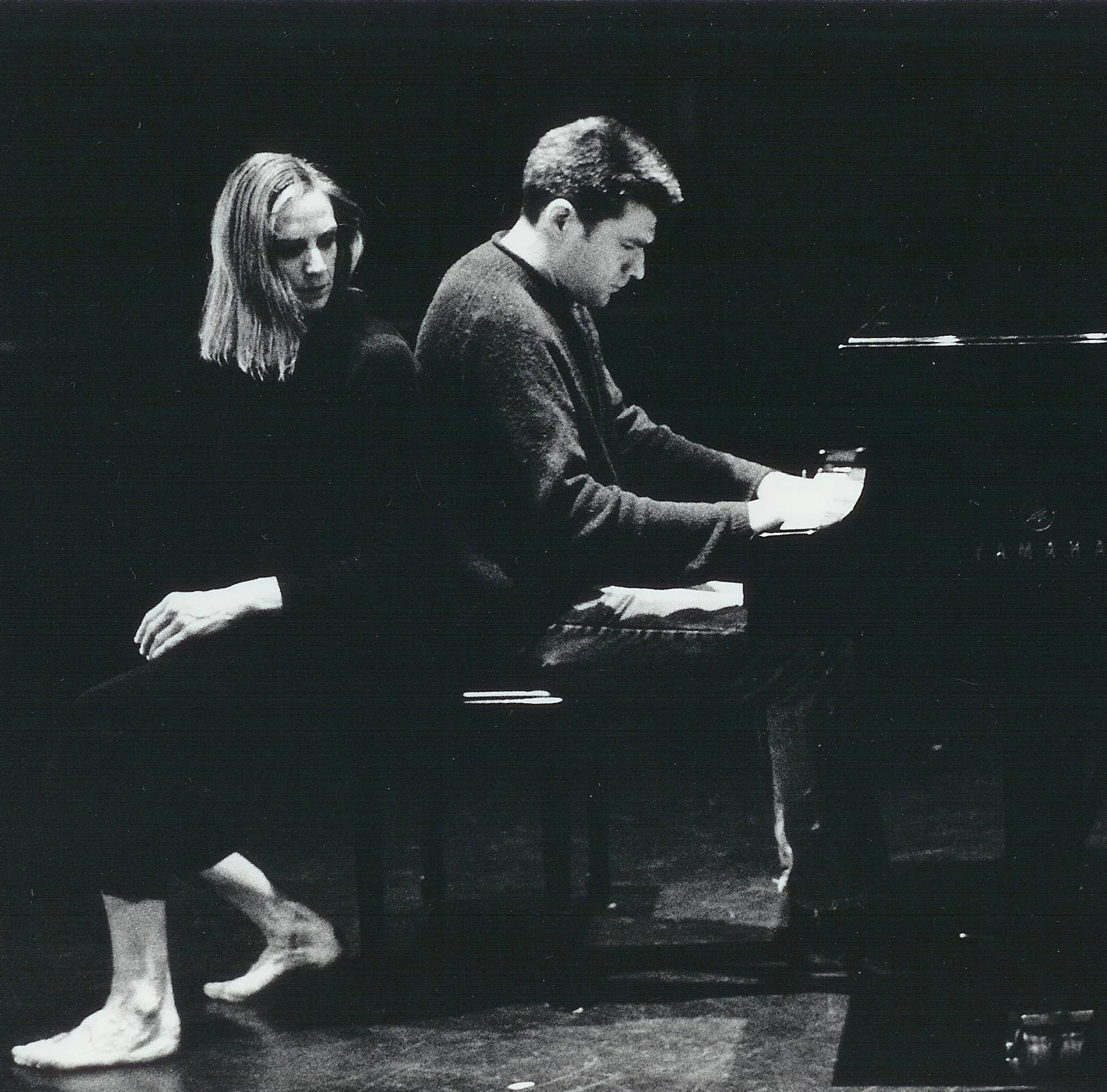
For this week’s blog, Peggy’s collaborator for twenty years, pianist Andrew Burashko looks back at their prolific partnership:
When I first met Peggy in January of 1991, I was at the threshold of a career as a concert pianist - a career I only ever imagined as a soloist, sometimes sharing the stage with other musicians - a solitary pursuit with not much room for anything else. I knew nothing of modern dance or any other kind of dance for that matter; and I only knew of Peggy Baker as the ex-wife of the composer Michael J. Baker with whom I had worked.
Peggy had just returned to Canada after a decade in New York and was looking for a pianist to perform a work that Mark Morris had given her as a gift when she left White Oak Dance Project. It was a work titled Ten Suggestions which was choreographed for solo dancer to Ten Bagatelles for solo piano by Alexander Tcherpnin. When Peggy first reached out to me, I saw it as a gig that would earn me some sustenance between ‘real’ engagements - solo recitals and concerto appearances. It seemed like a compromise - a job for a pianist incapable of commanding the stage on their own. This was my fragile, young ego talking, of course.
I remember showing up at the first rehearsal with a metronome to capture the exact tempi Peggy wanted, imagining that I would need to follow her. It was a relief to learn that she wanted me to play the music as I felt it. That was the beginning. For the next twenty years of our collaboration she encouraged me to choose the music – pieces I yearned to play – and allowed for my interpretations to inform her choreography. It was a revelation to see the music I was playing manifested in her movement. Not only in terms of her expression but also as a counterpoint. When making music with other musicians, everyone must be on the same page emotionally and intellectually. It’s not possible for one musician to be still or serene while a musical storm is raging around them. It was a shock to see her choreography seemingly contradict instead of mirror my idea of what the music was saying. It brought another level of nuance to my understanding of music.
Peggy also revealed an entirely new world to me by exposing me to the remarkable discipline and beauty of dance; and by helping me discover a new paradigm for myself as a classical musician. She brought me out of the spartan environment of the concert hall and into the magical and mysterious world of the theatre – lighting, staging, the possibilities of creating another world for the music – things I had never considered before and that I embraced and incorporated into Art of Time concerts.
The lessons were plenty and the growth profound. In short, I wouldn’t have found the path I am on today without having met Peggy.
Thank you dear friend. AB

Why the Brook Wept (1996)
As Peggy Baker and Andrew Burashko continue developing their repertoire together, Andrew suggests another John Cage score, Ophelia, composed for the American dancer Jean Erdman in 1946. Peggy writes about her response:
“That the music had been written explicitly for a choreographic portrait of Ophelia from Shakespeare’s Hamlet was both compelling and intimidating, and I hesitated to take it on. But the more I listened to the music, the more amazed and fascinated I was by the ways in which it captured Ophelia’s dilemma. Finally, I could not turn away.
To begin with, I worked strictly with the script of the play developing sequences, scenes and images based on the text. Once I had worked my way through the words I went back to the music, allowing the score to guide me in arranging, distilling, and refining the choreography. Also very much on my mind was the John Everett Millais painting Ophelia, (1851-2), which I had seen at the Tate in London many years earlier. I chose not to research the original choreography, so there are no intentional allusions to Erdman’s dance in my own. The description of Ophelia’s death as a fall “into a weeping brook” inspired my title.
One of the most potent images the music inspired for me was the idea of the pianist as Hamlet, and his performance of the score as his own wrenching self-interrogation. So the piano is positioned in profile on stage left, with the pianist’s back is to the dancer. At the end of the piece, the dancer is left on the floor, crumpled against the back legs of the piano bench, and once the final notes have decayed, the pianist closes the keyboard, stands and closes the piano’s lid and exists the stage. Whenever we performed this work, it closed the program, including on Art of Time Ensemble’s program, If music be… first staged in 2010.” PB
“The two dance sequences are beautifully rendered: Tanya Howard and Patrick Lavoie, as choreographed by James Kudelka in the Act III scene where Romeo and Juliet part after a night of lovemaking; and the remarkable Peggy Baker dancing Ophelia’s madness to music of John Cage to close the show.”
- John Terauds, The Toronto Star
"Cage composed the music for a 1946 dance by Jean Erdman, but Baker has made it her own, as much acted as danced. She passes through a full spectrum of moods, from languor to frenzy. When Burashko closes the piano and leaves her fallen figure on the stage, it is the spirit leaving the body."
- Susan Walker, The Toronto Star
To learn more about the work of John Cage watch John Cage. From Zero here on Youtube.


In a Landscape (1995)
The music and influence of John Cage is peppered throughout Peggy’s work, and it all began back in 1995…
“Pianist Andrew Burashko and I often gave one another books or CDs as gifts, and for our opening night at The Kitchen in New York in 1995, he gave me a CD of solo piano music by John Cage performed by Stephen Drury. The first track on the album was a piece from 1948 entitled In a Landscape. I instantly feel in love in with the music’s gently cascading melodies and the cresting and lulls of its compositional asymmetries. I lucked into an opportunity to perform a new work for fFIDA, (Toronto’s sadly no-longer Fringe Festival of Independent Dance Artists), and because Andrew was elsewhere, teamed up with pianist Henry Kucharzyk for the premiere.
The music took me inside of what I described then as my “creature body” – an interior world of sensations and movements riding the contours of joints and the pathways of blood, bone and muscle. The cycles of ritual that emerged elicited fragile balances and distortions that carved the lines of movement like the scarring and pruning used to cultivate a bonsai. Though this dance is brief, it moves through a timeframe that opens and elongates every second. The original staging of this work included a stunning costume by Jane Townsend – a kind of cocoon for the torso that left my bare arms and legs looking like the appendages of an insect – and a set of sculptural pieces by Kurt Swinghammer, some of which glowed at various times. Marc Parent, who lit this original version, later created a completely different treatment that called on the dancer to navigate a constantly morphing circle of light (imagine a rotating lava lamp projected onto the floor) that was devilishly difficult to balance within and which gave the impression of a dancer moving on a surface sliced out of the Milky Way.
I hold dear performances of In a Landscape with Henry, and later, and over many years, with Andrew. Performances of this dance by others, most especially Christopher T. Grider, Tanya Howard and Andrea Nann, have moved me deeply. “ PB
"A finely crafted solo, with carefully articulated movement perfectly matched to a John Cage composition." - Lewis Hertzman, Dance Magazine
“The estimable Andrea Nann puts her personal stamp on Baker’s 1995 solo In a Landscape; the choreographer’s own remembered presence in the same work hovers like a distant echo.” - Michael Crabb , The Toronto Star
Listen to Kurt Swinghammer being Interviewed by Steve Waxman here on The Creationists.
Watch the documentary John Cage. From Zero here on YouTube.


Assara (1995)
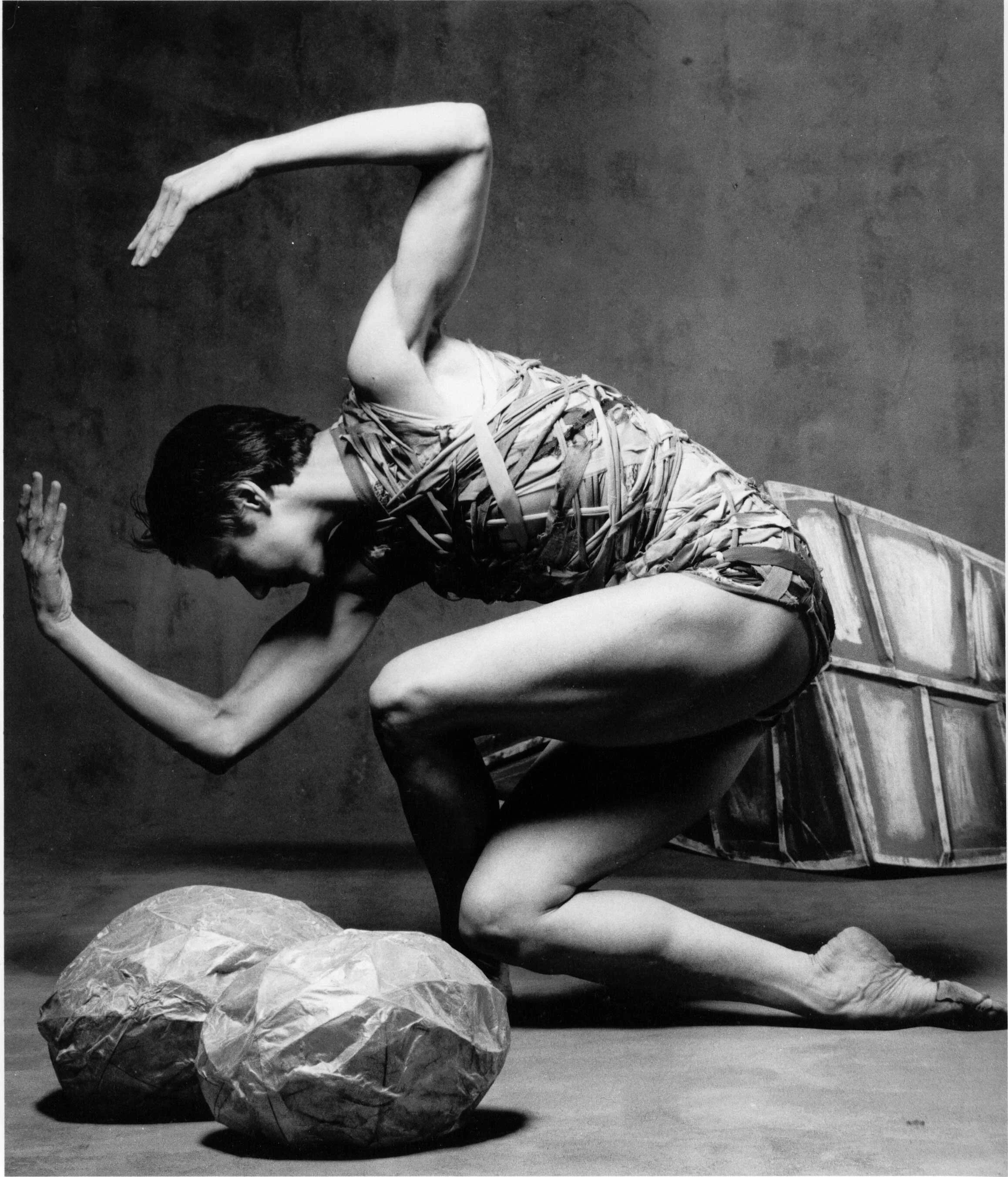
This week, Peggy looks back at a work choreographed for her by one of the founders of Toronto Dance Theatre, Patricia Beatty.
“Though she died in 2020, Trish will always remain a towering figure in my life. I met her in 1968 at a summer theatre school where she was teaching a daily movement class. The wisdom, sensuality and riveting immediacy of Trish’s dancing knocked me completely over. She inhabited her female body with grace and gravity. She spoke in the language of poetry - grand metaphors, invocations of the natural world, frank references to the body as the locus of desire, pleasure, intuition and creation. Up until that point I had aspired to become an actor, but from the day that I met her I understood that I had found my life’s work.
When I moved to Toronto in the fall of 1971 it was expressly to study with the company Trish co-directed, Toronto Dance Theatre. She always took my aspirations in dance absolutely to heart. Her guidance was honest and nuanced and she demonstrated through her dedication to the technique of Martha Graham that the physical practice of a dancer is an act of devotion. When, eventually, she was no longer capable of the rigours of Graham floorwork, she grieved the loss deeply. It was at this tremendously challenging time in her life that Trish suggested we once again intensify our relationship through the creation of a solo.
Trish’s highly specific and unique physicality permeated each of her dances, and it was an extraordinary experience to feel her impulses alive within my own body as I her danced her work. She was always extremely articulate about her choreographic intentions, so I’ll share her program note so that you can hear her speaking about this dance in her own voice” - PB
“Assara is a revered name from the ancient scripts of the pre-Hellenic islands of Crete and Cyprus. The word means pillar and it was used in these sophisticated civilizations to invoke the power of the Goddess. I have used it as a title for this dance about the renewal of true justice because we understand the symbol of a pillar of wisdom and a pillar of strength. The wise woman, once the central inhabitant of the female figure of justice, has been sadly and dangerously lost in our time. Where we look for fairness and compassion, we now see revenge and argumentativeness. This dance is a call for the renewal of true fairness and compassion in our thinking and practice of justice – it is also a call for the return of the wise woman into our lives and communities.” - Trish Beatty
To read more about the early years of TDT under the triumvirate leadership of Patricia Beatty, David Earle, and Peter Randazzo visit Dance Collection Danse here.