
Aleatoric Solo No. 2 (2016)
This week we reach the final piece in Peggy’s Aleatoric series, instigated way back in 2010 with the original Aleatoria installation created for Nuit Blanche. Peggy writes about this final work in the series:
In 2015, I made an unforgettable trip to Japan with the dancer Sahara Morimoto, who was at that time the Artistic Associate with my company. We had been invited by Helen Price to teach a week-long workshop for the Yokohama Ballet Academy, and we made it the centrepiece of a 3-week adventure that began in Kyoto and finished in Tokyo. At the Yokohama Museum of Art, we saw a spectacular retrospective exhibition of work by Takashi Ishida, and I was especially struck by a massive canvas that stood tipped up on its corner in the centre of a gallery. This canvas had been painted on over and over again in successive iterations. It had been gashed. It had light projecting onto it. It was an object, and an artifact of its making. It also presented an environment into which one entered. It was a performance.
The memory of my encounter with Ishida’s installation continued to work on me, and at some point I imagined the blank canvas with which he had begun. I thought about myself beginning a new work and my sense that I can never begin with a blank slate, an empty canvas, a tabula rasa. Rather, I have a sense that my fallibility, my flaws and inadequacies, the complexities of my history as both a person and an artist, mean that the “canvas” upon which I am working is already marred, marked, damaged. And so I took this idea of a “damaged canvas” as the central metaphor for my final aleatoric dance, a solo for the magnificent Kate Holden.
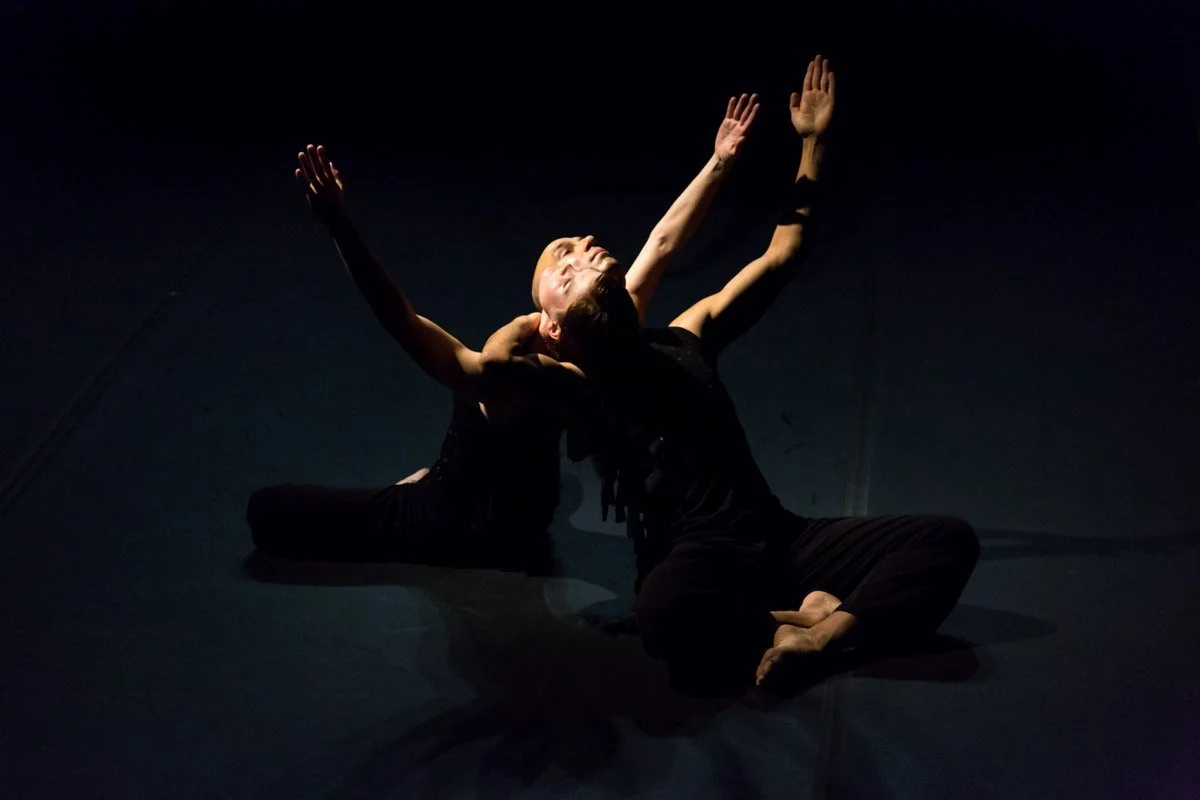
With a huge unpainted canvas ripped open with a long slash and tipped on its corner centre stage, Kate inhabited a world of light and shadow, transparency and opacity, within which she embodied prowess, vulnerability, fear, elation, fatigue, angst, and courage.
Her heroic solo – hugely demanding physically and vocally – closed the four-part program Phase Space. Composing each of those works was deeply fascinating for me as a choreographer, but my ambition with them was to create dances that possessed striking and unique identities that transcended the methods, mechanics, and mysteries of making them. The iconic American choreographer Merce Cunningham spoke eloquently on this point in relation to his own work: “Even with all this preparation, however complex it is, if it doesn’t become dance, then it’s meaningless.”
The concert in which this work featured, Phase Space, was honoured with a Dora Mavor Moore Award for Outstanding Sound Design for John Kameel Farah and Fides Krucker.


Aleatoric Trio No. 1 (2016)
Preparing for a concert in 2016 she titled Phase Space, Peggy created the first (and only) trio in her Aleatoric series. She writes:
I remained fascinated by the richness of developing dances as part of the aleatoric series (in which I had the dancers call up remembered movements from past works and then explored their potency within a new choreographic framework), and during the research for locus plot I encountered the concept of “phase space” which provided a powerful and stimulating new model for working in this way.
In physics, “phase space” is a term used to describe a disruption of time and space in which the laws of dimensional continuity and evenly paced, sequential time no longer hold true. Phase space can be transformed like working bread dough by stretching, flattening, folding, rolling, punching, and shaping so that the original relationship between any two points in time and space shift in radical and unpredictable ways.
I think of memory as functioning along the same lines as phase space. Certainly, it is a realm that exists outside of the usual conventions of spatial boundaries and linear sequencing. Memory unravels, floats, dissolves, reverses, contracts, expands, and spirals. In my experience, memory has more in common with dreams, fantasy, poetry, music, literature, and painting, than with the chronological experience we expect it to capture. A memory can languish in the constant flux of reinterpretation or become a narrative so polished it takes on the shining luster of a brittle shell.
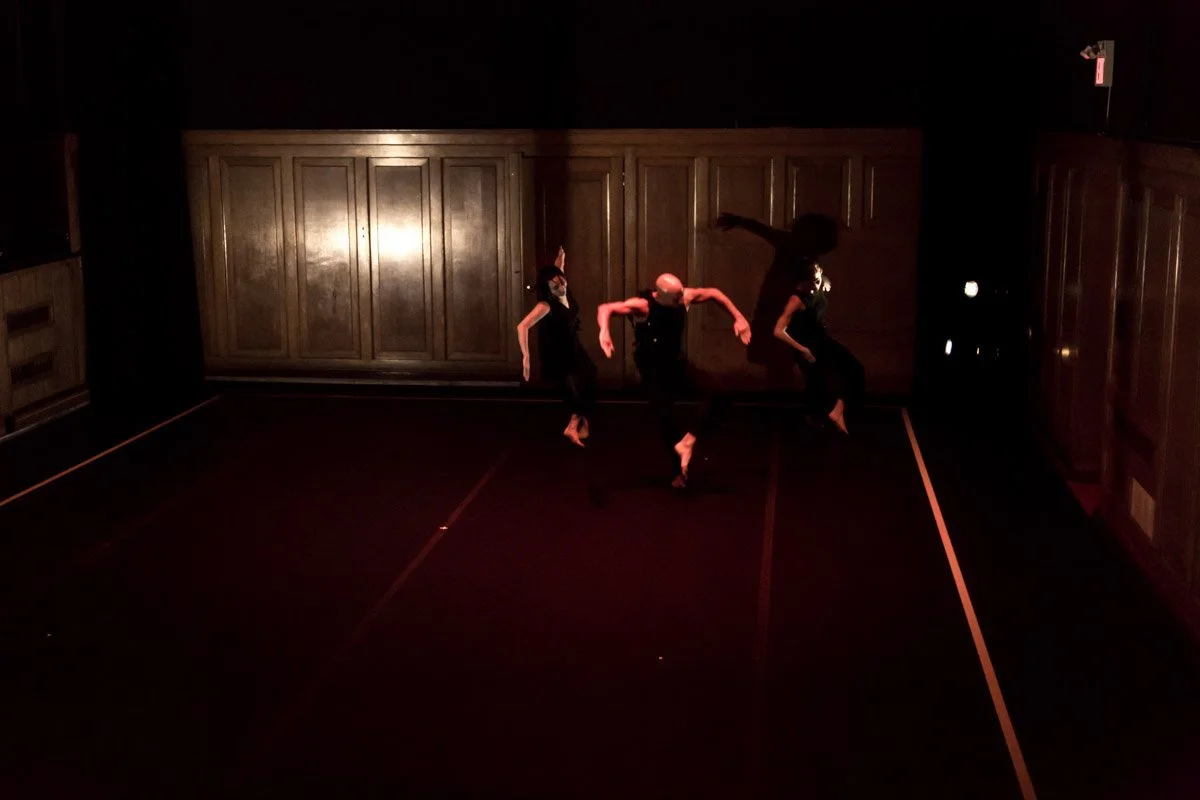
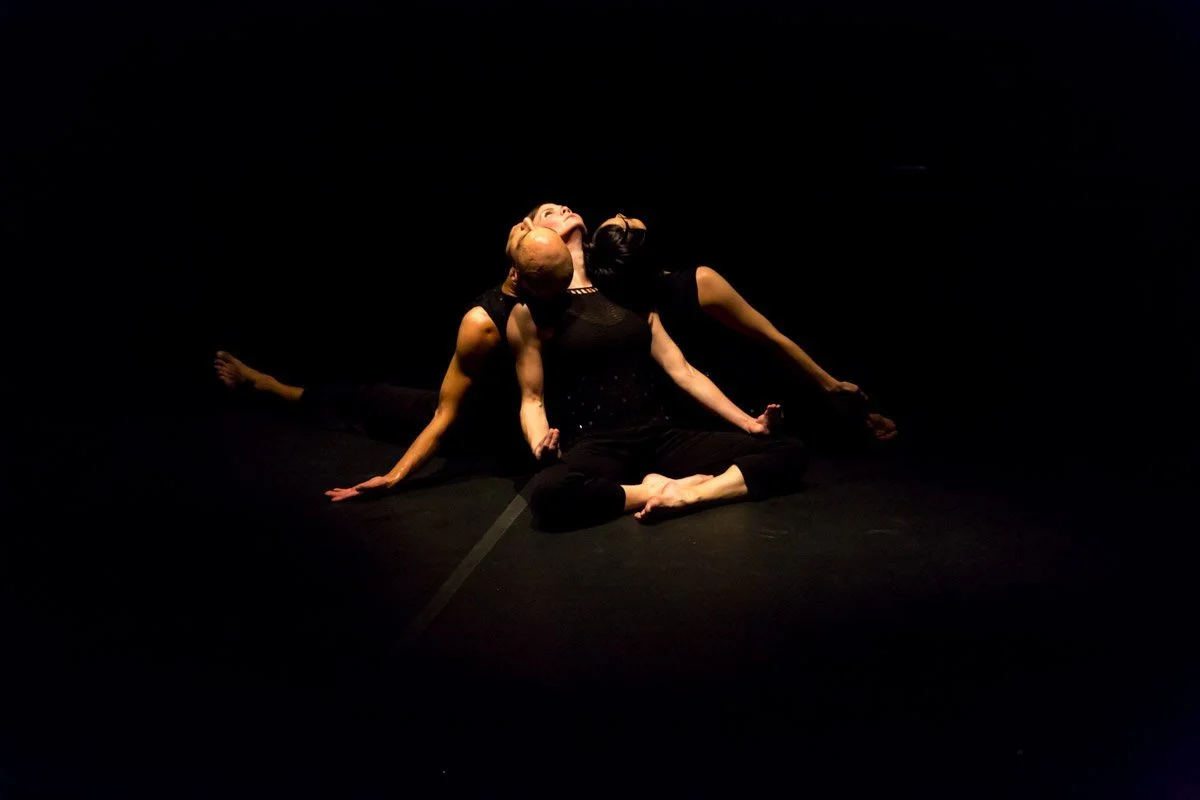
Working with Ric Brown, Sarah Fregeau, and Sahara Morimoto, I reconfigured the movement vocabulary they each brought forward as memories through the use of compositional structures, textures, energies, and themes that I pursued; by disrupting the space with a group of chairs (including two that were child sized) plundered from The Transparent Recital; by the integration of a demanding and far-ranging vocal score by Fides Krucker; and finally by situating musician John Kameel Farah on a ledge about 12 feet up on the back wall of the stage where he could look down to improvise an electronic score according to an open and spontaneous reading of his bird’s eye view of the performance.
Together, these contributions seeded a dreamscape unfolding within a shifting landscape of chairs, and revealing impulses, images, and oblique storylines that emerged from beneath the surface of the steps, amplified by voice, light and electronic sound. Reminiscing about this trio six years later, Sarah Fregeau said, “I loved that piece. All those chairs that were growled at and sung to.”
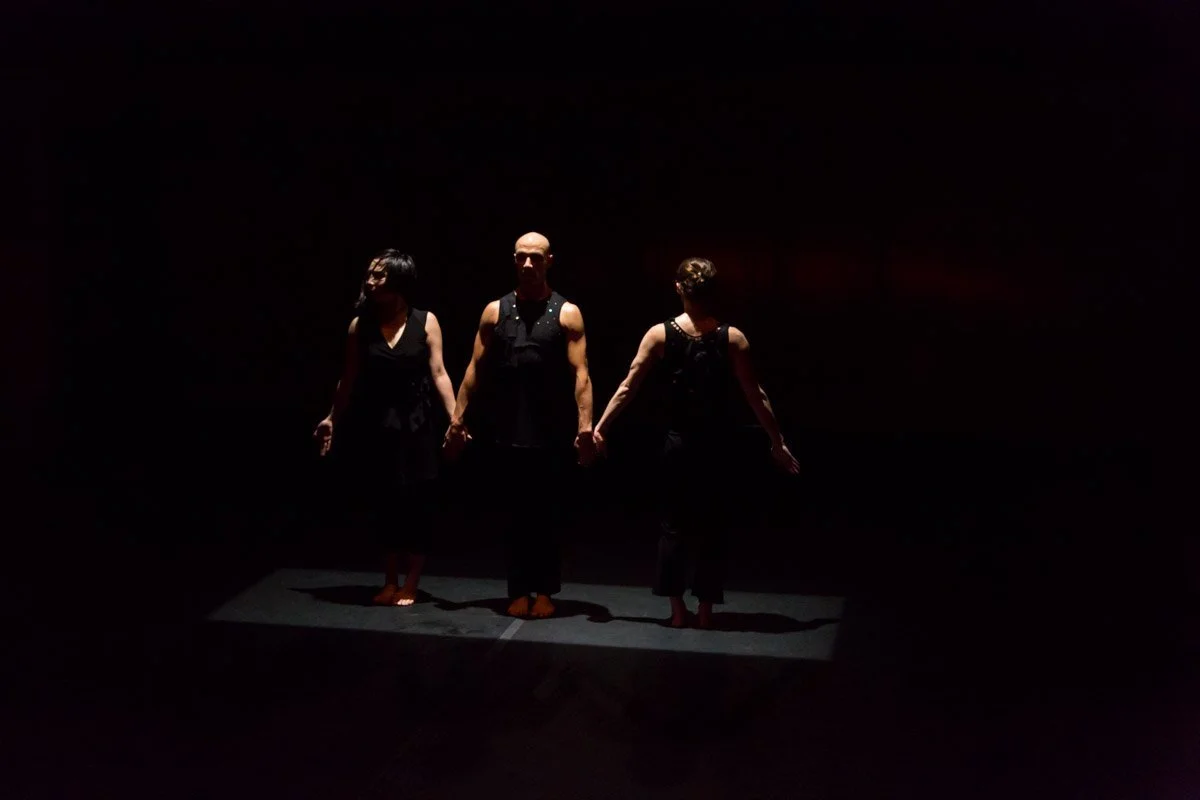
Aleatoric Trio No. 1 premiered as the opening work in a four-part program titled Phase Space, that also included Aleatoric Solo No. 1 for Sahara Morimoto, Aleatoric Duet No. 2 for Andrea Nann and Sean Ling, and the brand new Aleatoric Solo No. 2 for Kate Holden.


Split Screen Stereophonic (2013)
Although Peggy had folded mixed gender duets into some of her other works, 2013’s Split Screen Stereophonic is one of only two dances to focus solely on male/female partnering. Peggy writes:
I had a lot of different ideas rattling around in my head when I set out to make the double duet Spilt Screen Stereophonic. Covers of pop songs, vinyl records spinning on turntables, neighbours in apartment buildings living their personal lives on the other side of adjoining walls. I was thinking back on past relationships, about how distinctive the chemistry was within each of them, and I became intrigued by the idea of having two women perform the same choreography as the basis for duets performed simultaneously but developing very differently due of the actions, reactions, and interactions of the men.
Collaborating with Sarah Fregeau and Sahara Morimoto, we developed foundational material working with movement scores based on text from Eduardo Galeano’s sublime writing in The Book of Embraces. Once I brought in the women’s partners, I shifted to rehearsals focused on just one couple at a time – Benjamin Kamino with Sarah, and Sean Ling with Sahara. For a while we played with music by Joni Mitchell and Jane Siberry using the originals for one couple and covers by k.d. lang for the other.
When the time came to move away from the songs and consider music that would be more opened-ended, I thought instantly of a CD Debashis Sinha had released a couple of years earlier with his Berlin-based collaborator, Robert Lippok. I began matching tracks from Nuukoono with scenes from the dance and the fit was effortless – the shifting emotional tones and driving percussion of the music super charged all of the choreographic images.
Jennifer Dallas contributed the costumes – dark reds and browns for one couple and navy and slate grey for the other. Larry Hahn constructed a set that provided each duet with its own backdrop, and Marc Parent created a gorgeous lighting design filtering light through the drops and framing each side of the stage with sharp edges. The title calls up for me John Alleyne’s Split House Geometric, a dance that I always admired.
The original cast was sensational, but dancers who stepped into this work later – David Norsworthy, Ric Brown, Jarrett Siddall, and Kate Holden – also gave unforgettable performances. PB
“Split Screen Stereophonic dove right into the kind of chemistry and constant negotiations… in male-female couplings. Here the (Stereophonic) idea… was conceptually and physically split further in half as the women — Sarah Fregeau and Sahara Morimoto — entered, and in their separately halved sections of the stage, embodied in their active movements and ever-changing gazes, the similar yet different experiences in their relationship with a male partner…” David Fujino, Greater Toronto Chapter of the NAJC.


Aleatoric Solo No. 1 (2013)
Building on the creation methodology she first used in Aleatoria (2010) and then again in Aleatoric Duet No. 1 (2012), Peggy embarked on a new solo with her company’s Artistic Associate and dancer, Sahara Morimoto. Peggy writes:
The excitement of mining the movement vocabulary from my growing body of work, of allowing that material to evolve outside the framework of the choreographic context for which it was initially developed, and of focusing on new compositional forms continued to inspire me as I expanded the company’s repertoire of aleatoric dances.
Of the dancers in my group, Sahara Morimoto had by far the greatest breadth of experience within the repertoire, so working on an aleatoric solo for her offered a huge amount of source material. I invited to Sahara to choose freely from among the many dances she had inhabited, and within a just a few rehearsals we had an abundance of movement to work with. Jumping off from the double rectangles that Simon Rossiter had suggested for the duet with Nova Bhattacharya, I asked lighting designer Marc Parent to propose a frame for Sahara’s solo and he offered an elongated diamond – shallow, but wide – defined by a highly reflective mylar frame about a foot wide.
The solo began with the curtain opening on a stage being set up for the dance with improvising musician John Kameel Farah doing a sound check at a tech table on stage left, Sahara warming up in the middle of the stage, and the crew unrolling and taping down the mylar strips. Once the mylar frame was complete and the crew had exited, the first lighting cue came up and Sahara and John went directly into the performance. The detail, physical prowess, and dynamic variation of Sahara’s dancing was phenomenal. The short black shift she wore had a beaded mesh back that glinted and glittered in light reflected off the mylar frame. Sahara’s arms and legs etched the space calligraphically and the potency and gravitas of her persona elevated every moment of the choreography. PB
Discover Peggy’s impetus for her series of aleatoric works by checking out Guelph-based artist Ben Grossman and his double CD recording, Aleatoric Duets for Electro-Acoustic Hurdy Gurdy.


Photo of Sahara Morimoto by John Lauener.

Night Garden (2012)
By 2012 Peggy was well and truly bitten by the Nuit Blanche bug, and set out to create her third installation for Toronto’s all-night celebration of contemporary art. She writes:
The Betty Oliphant Theatre at Canada’s National Ballet School is a big, square auditorium fronted by the façade of a Victorian house that was designed by Jack Diamond. Seating for an audience of 260 rises for 8 rows from the main floor with a large balcony and box seating on both sides above. Surprisingly, the 8 wide rows of upholstered seats may be accordioned back to fit under the balcony, revealing an expansive floor directly in front of the stage.
Wanting to do something special and unexpected for Nuit Blanche, I was extremely excited about staging a work that could proceed with interruption for a full 12 hours on the house floor of the theatre, with the audience watching from above on three sides and coming and going freely throughout the duration of the work. To add to the surreal beauty of this overhead view, Larry Hahn created a set of 12 standing lamps – each with an undulating silver stalk crowned with a glowing white cone – that were arranged in clusters throughout the space.
Sourcing and then reworking foundational material from coalesce and Piano/Quartet, I developed a 20-minute choreography to be performed successively by four different casts, and with each cycle overlapping in the last few minutes as the work was passed on to the next trio. The extraordinary dancers for this project were Ric Brown, Sarah Fregeau, Kate Holden, Benjamin Kamino, Megumi Kokuba, Amanda LaRusic, Sean Ling, Sahara Morimoto, Andrea Nann, Jessica Runge, Stephanie Tremblay Abubo, and Natalie Westerbeek. The dancers’ black sequined costumes – each one unique and artfully crafted by Jennifer Dallas – glinted in the glowing lamplight, while a gentle, shimmering score by Debashis Sinha resonated throughout the space.
The emotional potency of this durational dance worked on me more and more deeply as the night progressed, and when the final cycle was completed and the space was left empty, and then quiet, and then dark, I was overwhelmed by the feelings of profound grief I had been carrying for the 20 months since the death of my husband.


Piano Quartet (2012)
Having created three works to piano music by John Cage – In a Landscape, Why the Brook Wept, and furthermore – and with a deep appreciation of his tremendous influence on the development of western music forms, Peggy marked the 2012 centenary of Cage’s birth with a new work in his honour. Peggy writes:
Immediately following its publication in 1996, I began working my way through the dense and stimulating MUSICAGE: Cage Muses on Words Art Music (John Cage, Joan Retallack). Cage had died four years earlier, and this book documented an extraordinary series of in-depth interviews in the last months of his life during which he reflected upon the full breadth of his artistic endeavours. Among countless pleasures, this book provided my first encounter with Cage’s poetry. More than any other writing I know, Cage’s poems (he calls them mesostic texts) feel to me like choreography – in the way that a single idea is pulled apart and reconfigured over an expanse of time, moving beyond the explicit language employed to call up images and juxtapositions that emerge, transform, catalyze and dissolve.
As the centenary of Cage’s birth approached, I began experimenting with his mesostic texts as the basis for movement scores. The process was instantly exciting and generative, so I began listening in earnest to his many works for prepared piano. Commissioned to create a brief solo for dancer Brian Lawson, I chose Cage’s Music for Marcel Duchamp, composed in 1947, and the beauty and fascination I found in that first dance led directly to the decision to tackle Cage’s epic Sonatas and Interludes for Prepared Piano.
Piano/Quartet arose through that foundational solo for Brian Lawson (who worked alongside Sahara Morimoto); through subsequent choreographic research during two residencies in Philadelphia (Dance Advance, Pew Centre for the Arts and Heritage / Bill Bissell, director) involving dancers Gregory Holt, Bethany Formica and Shannon Murphy, and ultimately through intensive work with dancers Ric Brown, Sean Ling, Andrea Nann, and Sahara Morimoto.
Caroline O’Brien created a sensational wardrobe that allowed the dancers to switch up costume pieces for each scene; Marc Parent devised a gorgeous and eventful lighting design; and the production was completed with a series of beautiful, painterly projections by Larry Hahn. Upstage centre seated at a grand piano, completely unflustered by the flashing changes in the lighting and projections, and by the rustle, footfall, heavy breathing and constant movement of the dancers, pianist John Kameel Farah gave an astonishing series of virtuosic performances of some of the 20th Century’s most challenging and daring music. PB
“…mesmerizing…Epic in scope, inventive in structure and emotionally nuanced…” Michael Crabb, The Toronto Star


Aleatoria (2010)
Peggy was bitten by the Nuit Blanche bug early! After creating move in 2009, she followed up the next year with a new, all-night durational work, Aleatoria.
Peggy writes: Debashis Sinha was my Musical Director for the premiere of move at Nuit Blanche, and he had brought in some other improvising musicians who all played together, switching off as to who was leading. Phil Strong, Ben Grossman and John Gzowski joined Deb, and the shifts in the sonic environment throughout the 12 performances between 7pm and 7am offered tremendous support and stimulation to the performers.
Ben gifted each of us involved in move with his new double CD release, Aleatoric Solo Duets for Electro-Acoustic Hurdy Gurdy. The two CDs were designed to be played simultaneously with each CD player set to shuffle so that the tracks – which were varying lengths – constantly recombined. I LOVED this concept as a premise for a durational dance and immediately beginning planning for Nuit blanche 2010.
I brought together 11 dancers who had been involved in past performances of my work and asked them to call up any movement memories they carried from those dances and to use them as the basis for improvised episodes that would last 10 minutes. ‘Aleatoric’ means randomly or by chance and taking that invitation we used a chance procedure to determine the order of dancers each hour. The 12-hour performance began with a single dancer who was joined by a second dancer after 5 minutes and replaced by a third dancer at the 10-minute mark and so on and so on throughout the night. I joined Kate Alton, Nova Bhattacharya, Sylvain Brochu, Sarah Fregeau, David Houle, Sasha Ivanochko, Sean Ling, Sahara Morimoto, Andrea Nann, Jessica Runge, and Brodie Stevenson – each of us dancing as soloists but also spontaneously creating duets with one another to Ben’s gorgeous music as it spun out over the hours.
Find out more about the hurdy gurdy here on YouTube.
Film-maker Midi Onodera captured time-lapse movies. You can watch them here on her website.


coalesce (2010)
coalesce is Peggy’s first ensemble work to be included in her company’s main stage programming. It premiered in Toronto in a concert titled Confluence, presented at EnWave - now Harbourfront Centre Theatre.
Peggy writes: After 20 years of making solos for myself, I was extremely curious about what might happen if I engaged in a creative process with a small group of dancers. I thought that a trio would be within reach for me and brought together as the cast three dancers I deeply admired – Kate Holden, Sean Ling and Sahara Morimoto. I had used one of Sylvia Safdie’s films as a foundational resource for my solo earthling, but there were several others of two insects together and of whole groups of insects that were also fascinating, so I started there.
The dancers and I dug in to learning about communication among insects via pheromones, and played with movement patterns inspired by the many insect appendages including 3 sets of limbs, antennae, wings and mandibles. A very particular sensibility arose by shifting concepts around sensory discernment and by working with the idea of an exoskeleton – a hard, brittle exterior. The trio that arose was highly stylized and absolutely fascinating to watch.
Debashis Sinha was present in the studio with us, sitting at his computer and wearing a set of headphones so that he could develop the sound design parallel to the emergence of the choreography. It did take me some time to land on the proper costuming, but in staging an excerpt of coalesce for the graduating class at The School of Toronto Dance Theatre, Jennifer Dallas created a fantastic set of costumes and I turned to her to make a new set for my company using the same design.
I took intense pleasure in creating this dance with Kate, Sean, Sahara, and in the new ways of working that arose with Deb and with lighting designer Marc Parent. I knew without a doubt that I had found a way forward beyond making and performing solos, and I moved eagerly into a new phase in my dance life. PB
“Baker's new program indeed transports us to an otherworldly place beyond conventional human experience.” Read more from Michael Crabb’s review in The Toronto Star
The dancer and the insect expert is an article about the involvement of Dr. Darryl Gywnne, a behavioural ecologist and professor of biology at U of T Mississauga in Peggy’s presentaton of Confluence.


Geometry of the Circle (1993)
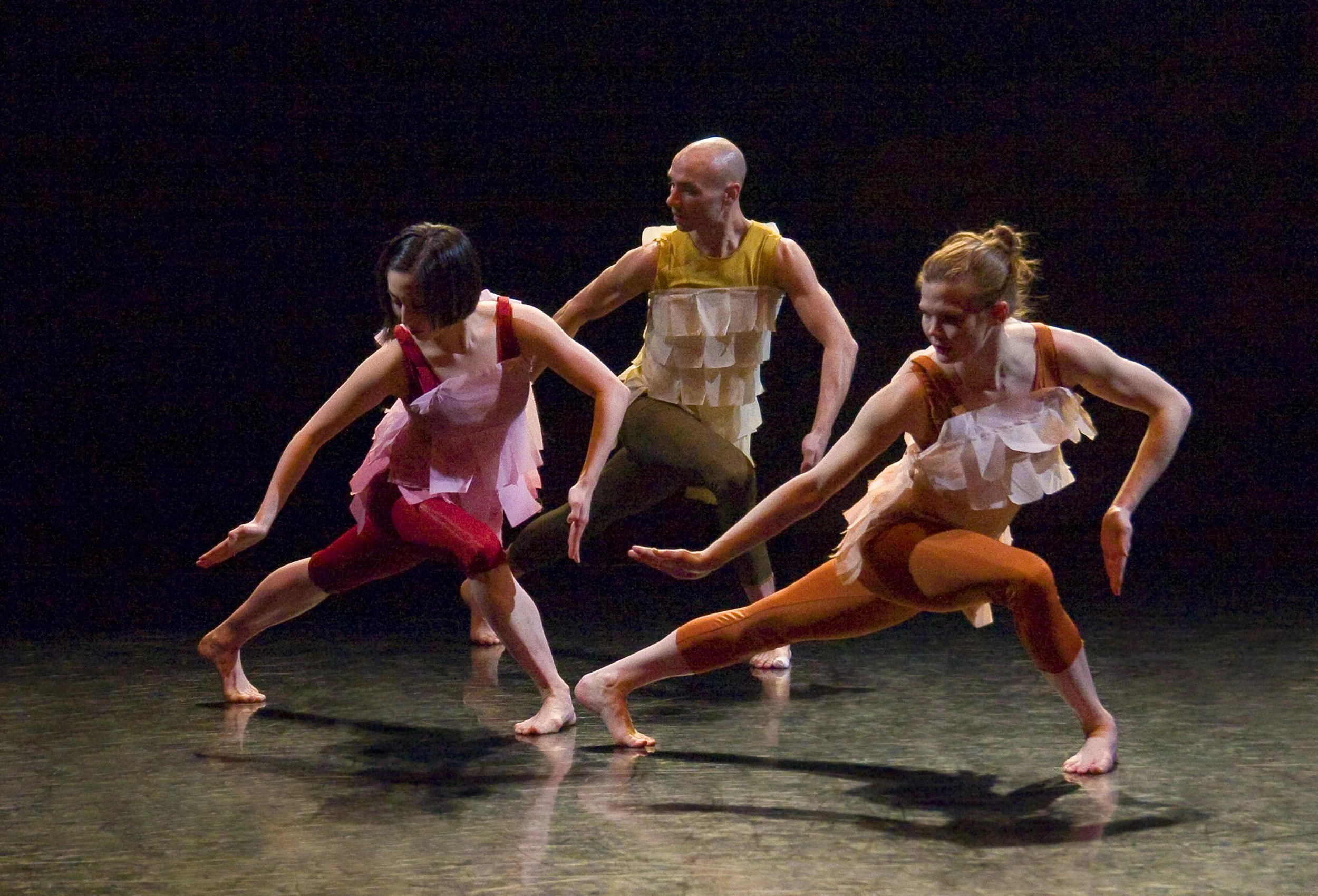
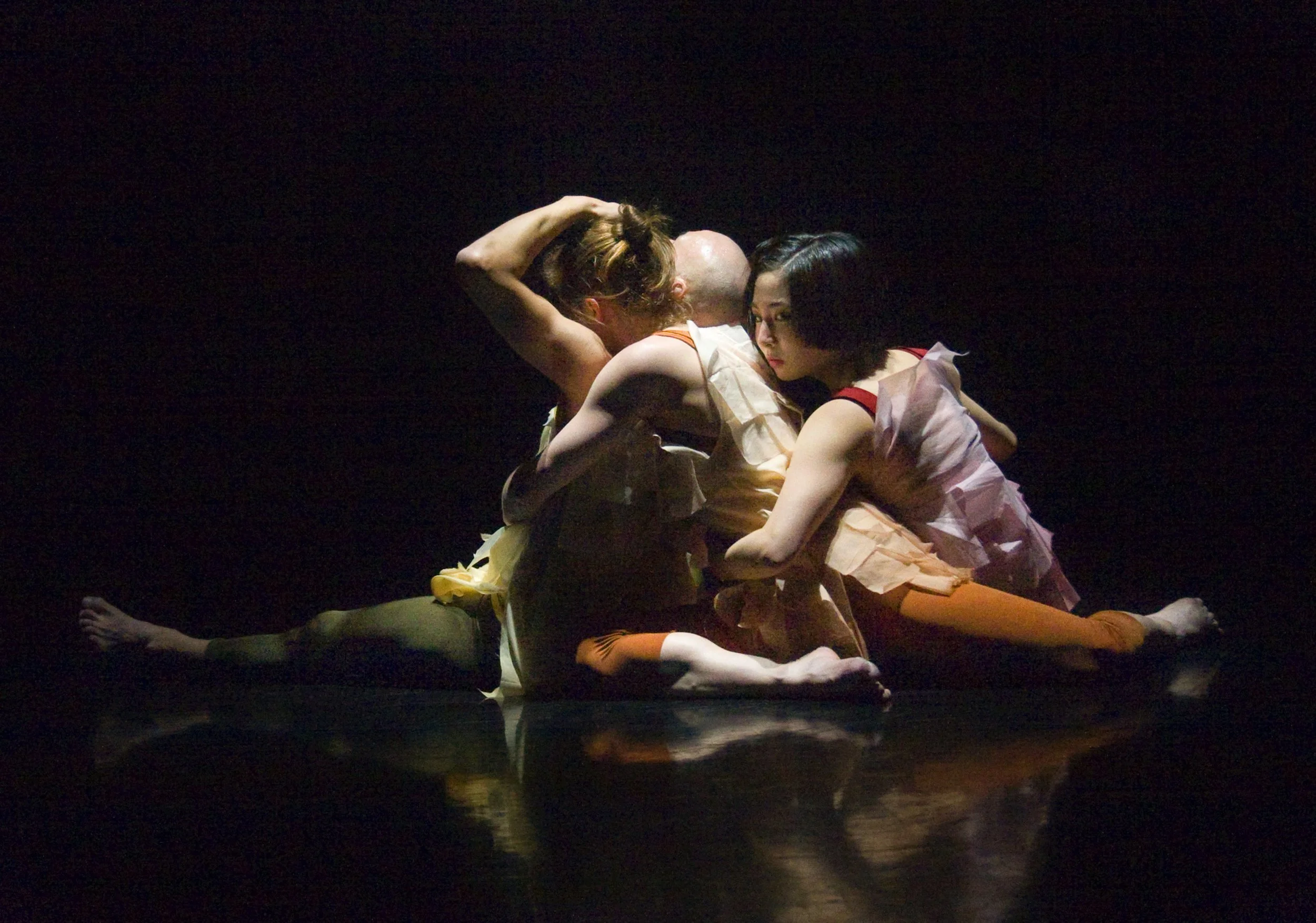
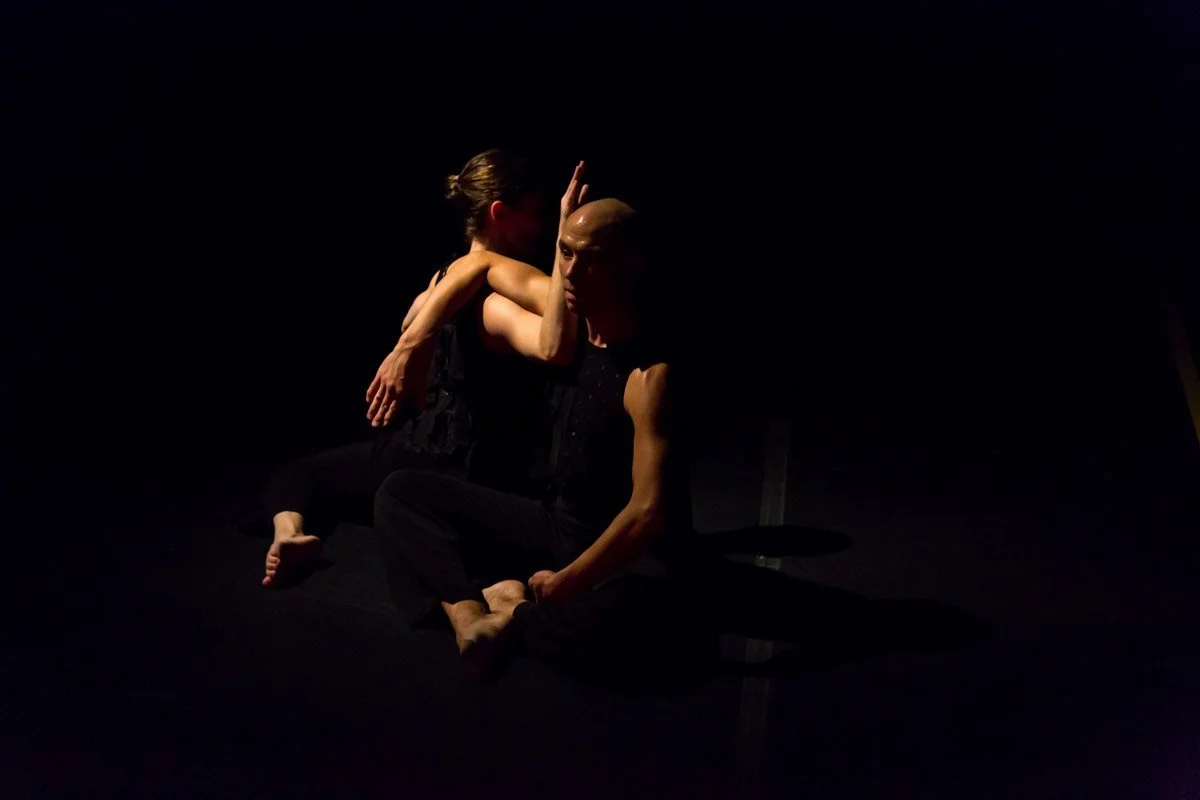
Now well into the third year of Peggy Baker | Solo Dance, Peggy is generating much of the new work herself, collaborating largely with Toronto-based musicians and composers. This early period of her work as a choreographer established live music as a distinguishing feature, with the musician not present as an unseen accompanist, but as an equal performance partner alongside her onstage.
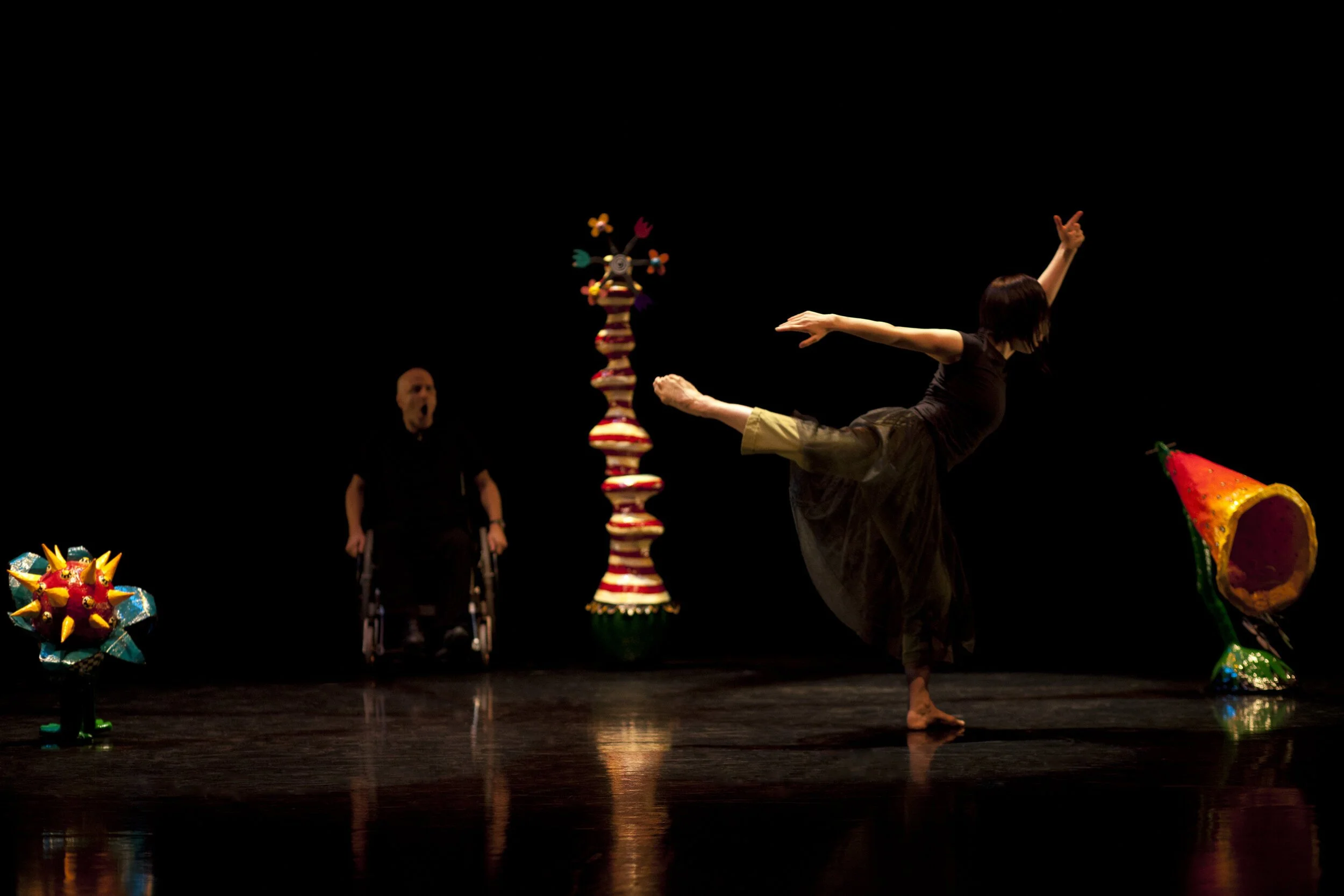
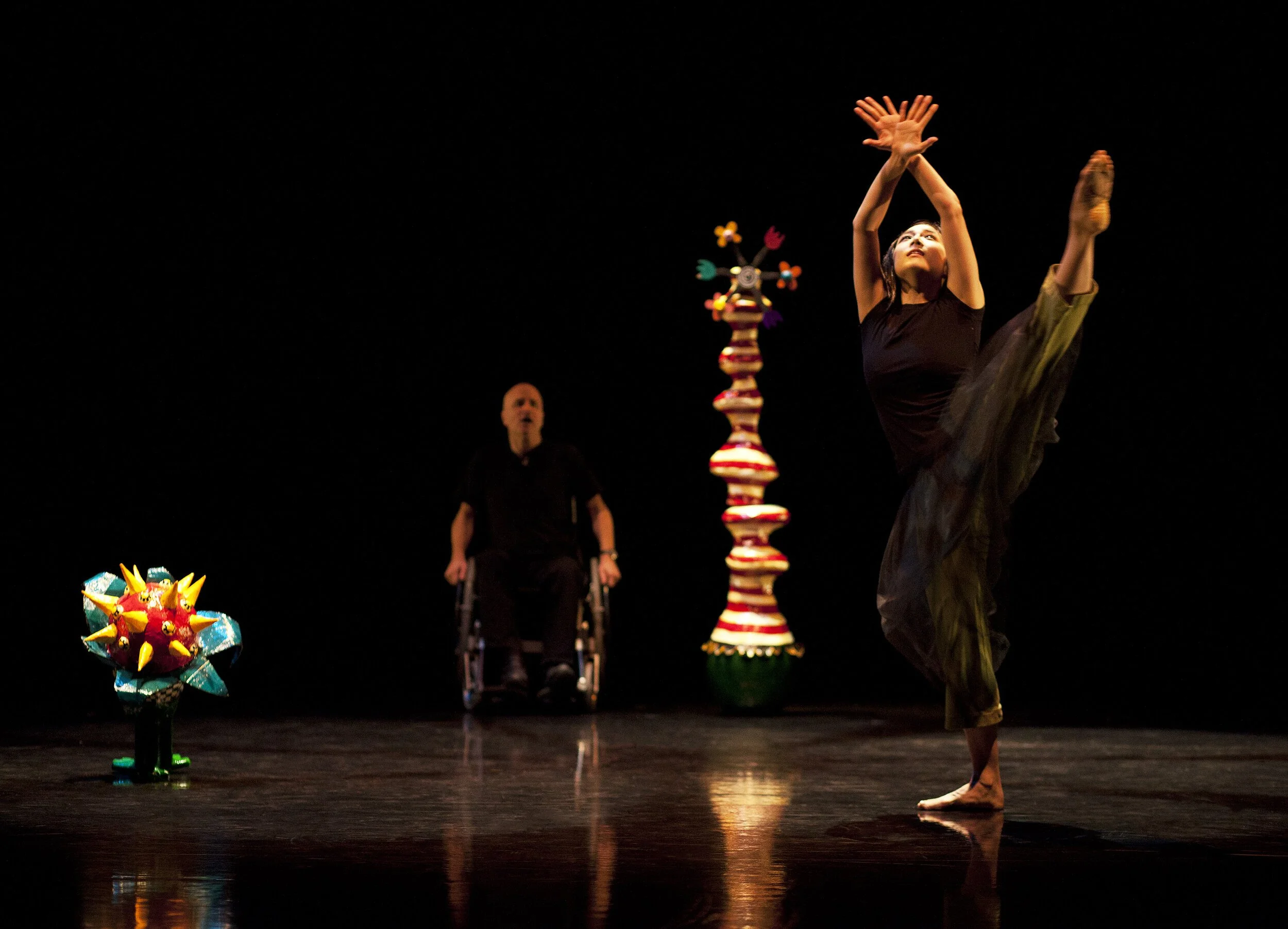
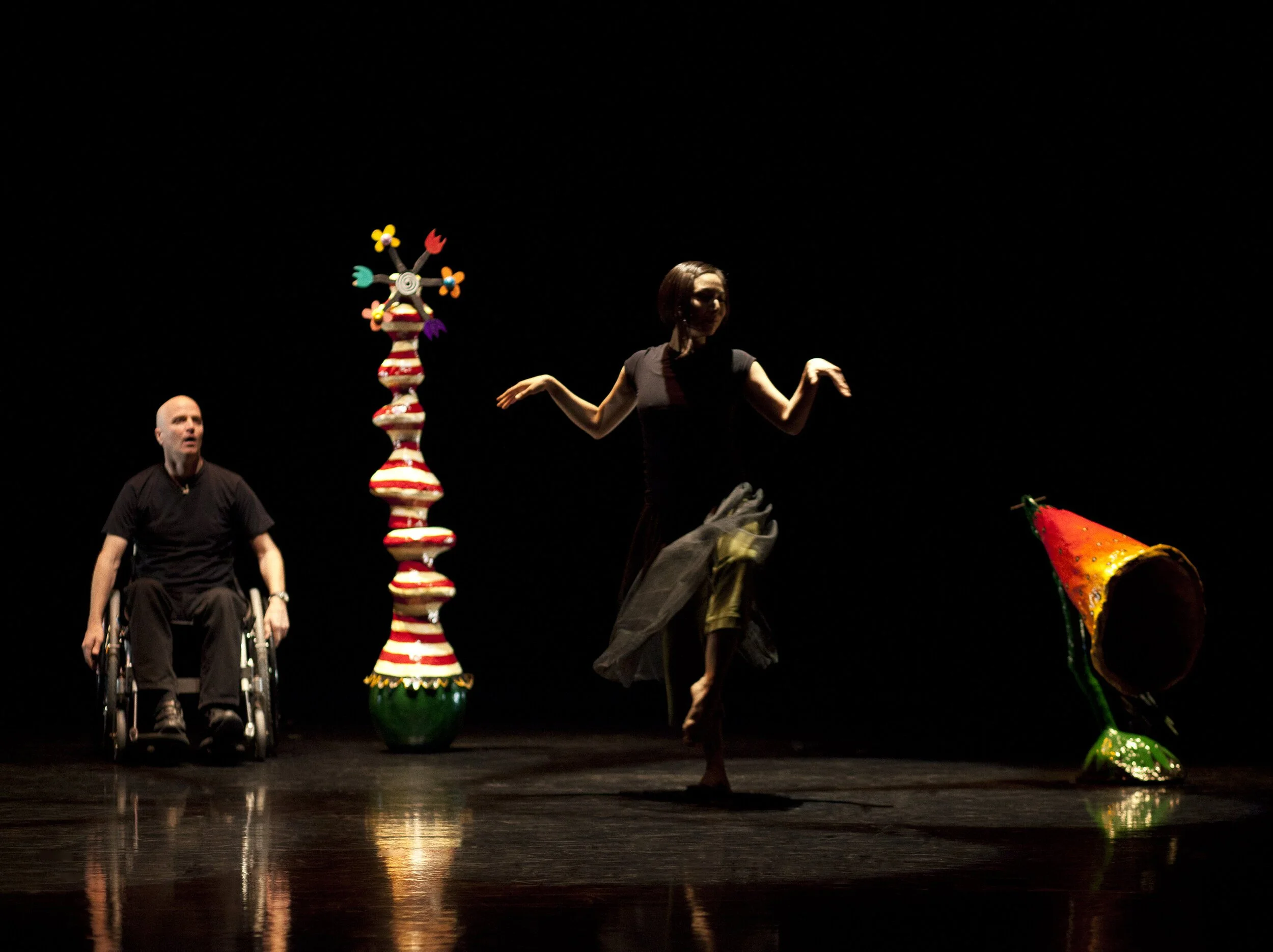
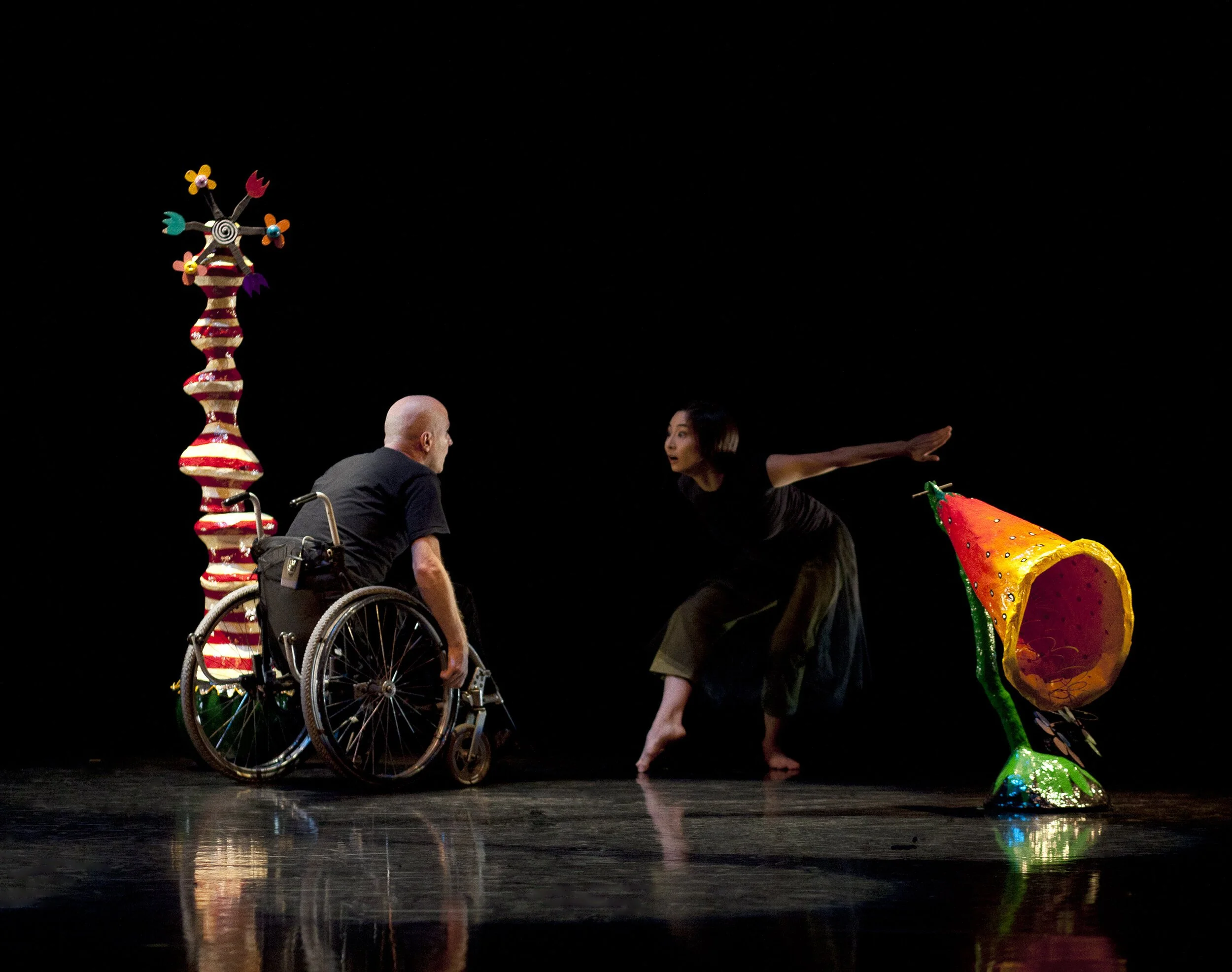
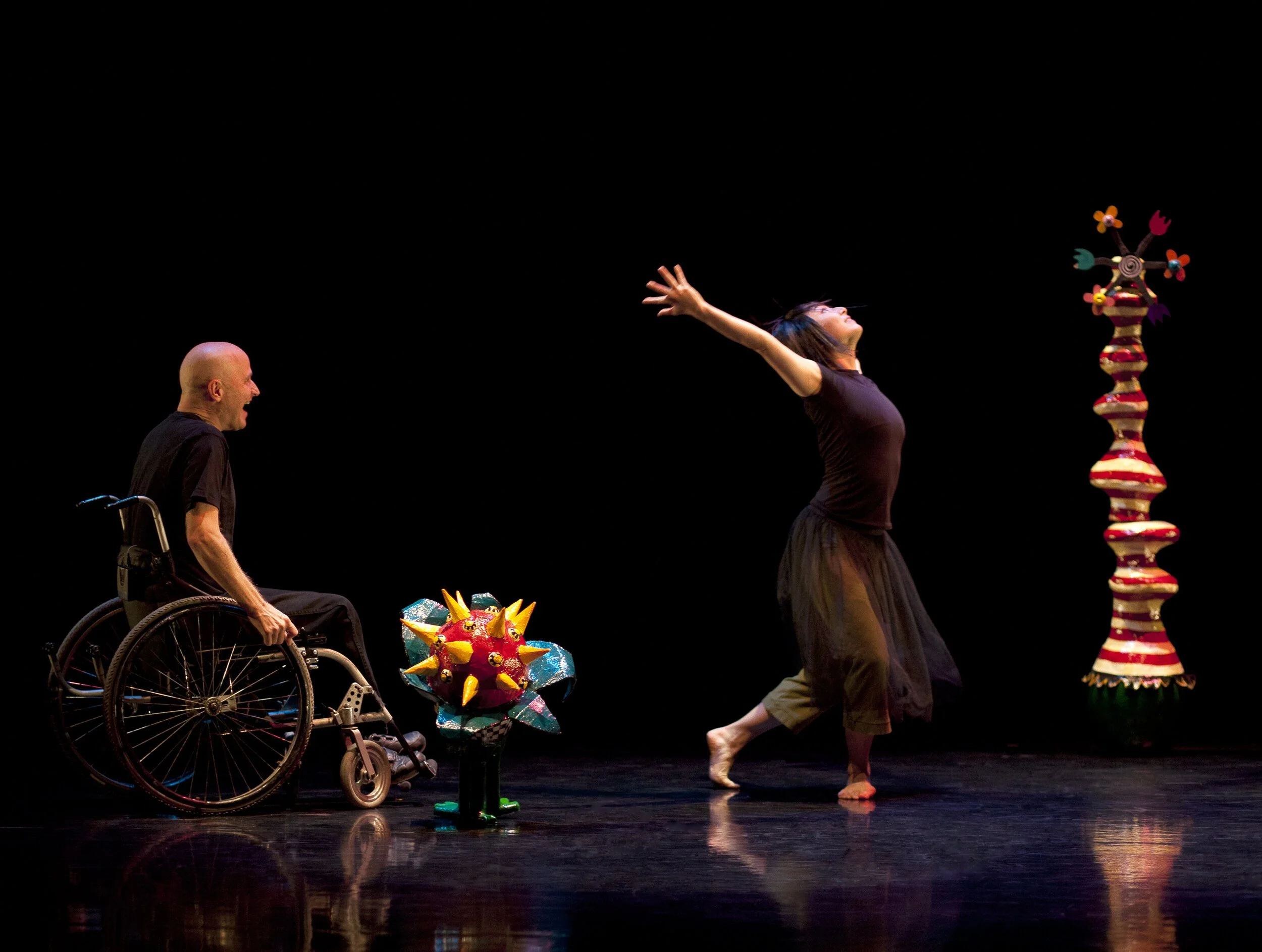
“For this second work together, Ahmed Hassan and I started by reversing the rules we’d established for Sanctum, in which we were set far apart, each confined to our own small rectangle of space, and for which Ahmed’s music was comprised purely of percussive sound. For this new work, we had sculptor Janet Morton create a set of three objects to define the circumference of a circle, and Ahmed and I discovered and pursued one another within this miniaturized world. We thought of ourselves as entities with distinctly different modes of expression and communication: Ahmed a creature for whom sound was primary, and me a creature of gesture and action. Wearing a wireless mic, Ahmed careened about the space in his manual wheelchair while I bounded and scampered away from him and toward him, finally meeting face to face, stepping inside the footrests of his chair, grasping him by the shoulders, and lowering myself to squat back on my heels while we met eyes and he “sang” to me.
An invitation to revive Geometry of the Circle for performances as part of the cultural celebrations for the 2010 Winter Paralympics in Vancouver led to a decade of rich collaboration with the vocalist Fides Krucker. First interpreting and reconstructing Ahmed’s extraordinarily eccentric vocal score, Fides then taught it to performer Mark Brose, coaching him in the intricacies of a virtuoso performance that he shared with two exquisite dancers: Alison Denham and Sahara Morimoto.
Geometry of the Circle is as dear to me as a love letter, inscribed with the disappearing ink of live performance.” PB
"Hassan...earthbound...confined to a wheelchair... (Baker) his velvet-jointed sylph...a celebration of mutual power, and of constructive differences." - Robert Everett-Green / Globe and Mail
Read about Janet Morton knitting a cozy for an entire house on Ward’s Island here on Torontosavvy.com. For a more academic analysis of Janet’s work, read Emily Jane Rothwell’s Master’s Thesis here.