

Heaven (2003)
This week we continue to look at a rich period before and after the turn of the millennium, during which Peggy worked with master choreographers from across Canada and the USA. We’ve arrived at the creation of Heaven for Peggy and pianist Andrew Burashko by award-winning NYC-based choreographer, Doug Varone.
Peggy writes: In 2003 Doug Varone brought together a quartet of dancers for a concert at Jacob’s Pillow titled Short Fictions. Esteemed Limon dancer Nina Watt, Varone Co. veteran Larry Hahn, and I were all in our fifties – with Doug not far behind – all of us baby-boom dance-boomers crossing a fifth decade threshold that had been extraordinarily rare in the previous generation. The program opened with Four Piano Pieces, the first three all Varone masterworks – Nocturn (Chopin), Aperture (Schubert), and Short Story (Rachmaninoff) and it closed with a new work for me with pianist Gabriela Imreh, Heaven, to Cesar Franck’s Prelude, Fugue and Variations.
Heaven is kind of memory play in which the pianist and the dancer each seem to be alone remembering the other. I push against the piano, lean into it and stroke its surfaces. At one point I withdraw the stick holding the piano’s lid open and it slams closed. I sit on the bench back-to-back with the pianist; take their shoulders in my hands and move them; touch their head; lift their hands from keyboard; and even play some of the notes myself. The disruptions to her physical rapport with the piano were, understandably, unsettling to Gabriela, and the tensions provoked became central to the experience of the performance and to the images and associations that arose for the audience.
From the outset, Heaven was intended for my own repertoire, and Doug created it with Andrew Burashko and I. I remember us working in a New York studio with Andrew playing an upright piano with a table set against the side edge of the keyboard so that I could approximate movements against, along, and over it. Andrew was not thrown off at all by the extent and frequency with which the choreography implicated him. The one exception was when I played notes of the music, and due to his precise ear, my touch and timing required on-going coaching.
This work, with its evocations of absence and longing arising from music, holds in it the essence of my experience now, in hearing the music I once lived in as a dancer. - PB
For Facebook people, watch the performance of Heaven in full here on the Art of Time Ensemble Page.
Doug Varone’s Aperture can be seen on Youtube here and Short Story can be viewed here.


Unfold (2000)
In 2000, the decade-long collaboration between Peggy Baker and Andrew Burashko sees them tackle a major new work suggested by Andrew: Aleksandr Scriabin’s 24 Preludes, Op. 11. Peggy writes:
“Andrew had been proposing this work for some time, and the gift of commissioning funds from Symphony Space in New York and the National Arts Centre in Ottawa – with performance dates that fell just a month apart – provided the perfect opportunity for us to dedicate ourselves to the development of this demanding work.
Like Chopin’s 24 Preludes, Op. 28, (which served as his model), Scriabin composed a short work in each of the major and minor keys of classical western music, and despite this academic premise, his 24 pieces are charged with deep emotion. Some sound as though they are at a loss to complete themselves, while others give the impression that they are about to float apart, combust, collapse inward, or dissolve. A couple of them are as conclusive as a slammed door at the end of a heated argument. Taken as a group they propose what I can only describe as a self-portrait of the composer, and any pianist taking them on must transcend their highly personal specificity and bring a singular interpretation to the score.
I wanted to step up to the score on these same terms, discovering within the style and scope of the music a framework within which to reveal myself with immediacy and authenticity. Ultimately, Unfold offered the audience an intimate experience of Andrew and I as individual artists and as artistic collaborators, but also simply as very different people who have built a deep friendship by bringing our worlds together.
Unfold falls half-way through the 20-year arc of my shared performance life with pianist Andrew Burashko and looking back I see that this was the last of my choreographic works to be created with him; the new dances that followed for he and I were the work of others – Doug Varone, James Kudelka, and Molissa Fenley.” PB
“Baker’s angular, constructivist choreography seems a part of the music, another instrument playing the melancholy themes. Sometimes she dances in silence… Sometimes Burashko plays alone. In those passages the ghost of the music and the after-images of Baker’s movement are ever-present.” - Susan Walker, The Toronto Star
If you’re looking for any information on Aleksandr Scriabin, the Scriabin Association has you covered and then some.


furthermore (1999)
If you’ve been following the blog for a while, you’ll know that by 1999, pianist Andrew Burashko and dancer Peggy Baker had been touring Canada and the USA together for almost a decade. They often included a piano work for Andrew to perform without any dance, and in this week’s blog Peggy recounts how Andrew’s choice of Piano Music No. 2 by John Cage led to the creation of furthermore:
“For this particular composition, Cage had employed the chance procedure of taking flaws in the manuscript paper on which he was notating and assigning them musical notes, some of which would be played on the keyboard, and some by striking or plucking the string directly, reaching inside piano. This piece therefore required that the musician stand at the piano in order to be able to play both the keyboard and the strings simultaneously, while also shifting their weight to extend a leg to work the pedals that sustain or dampen notes. I found the movements required of Andrew quite beautiful, and highly choreographic.
In the fall of 1999 Andrew presented his first recital program for a new music performance initiative under his artistic direction, Art of Time Ensemble. Contemporary music by Americans John Cage, Peter Lieberson, George Crumb, Sebastian Currier ,and George Gershwin was brought together in a program titled Fascinatin’ Rhythms. Along with Andrew, the stellar musicians on the program included Steve Dann (viola), Beverley Johnston (percussion), Barbara Hannigan (soprano), and Joel Quarrington (double bass). I danced to Cage’s Piano Music No. 2, and my choreography was an elaboration on Andrew’s actions so that the work became both a piano solo and a movement duet. I titled the premiere and, moreover, and later renamed it furthermore, though I can no longer imagine why I thought it needed to be changed…” PB
To read more about how John Cage redefined music, visit NPR here.
Art of Time Ensemble has become a live performance juggernaut in Toronto. Andrew’s company presents an annual season of concerts that fuse high art with popular culture. To listen to a selection of their recordings visit Soundcloud here, or their YouTube channel.


Encoded Revision (1997)
By 1996 Peggy and pianist Andrew Burashko had a repertoire that included 19th century western music by Brahms, Chopin and Liszt, early 20th century music by Tcherepnin, mid century compositions by Prokofiev and Cage, and one late 20th century new music work by American composer Peter Garland. What would be their next focus? Peggy fills us in:
“When I opened a conversation on commissioning a new work, Andrew immediately suggested Michael J. Baker who was extremely active in the Toronto music scene as a composer, conductor, and multi-instrumentalist and had been composing for dance since the early 1970s. We quickly agreed on Michael (whose last name I share because we had been married for 12 years of our young adult lives) and were ecstatic when my newly incorporated company, now called Peggy Baker Dance Projects, secured our first ever grant to commission the music.
The score for Encoded Revision requires a performance of post-modern virtuosity by the pianist who is constantly shifting metre and tempo, has text to deliver throughout and is also called upon to manipulate the score pages as props within the choreography. I loved performing this dance, but the choreography did not meet its potential until it was revived with Benjamin Kamino 16 years after its premiere.
The program notes give a full overview of the form and content of the piece:
The creation of this work was based on the literary form of the palimpsest: a document written upon several times, with remnants of earlier, imperfectly erased writing still visible. A palimpsest simultaneously documents and destroys its own history, encoding the original text within a revision.
Buried inside of Encoded Revision, and serving as the original document for the musical palimpsest, is a newspaper account of the tragic death of the composer’s great grandfather in a train accident on the Canadian prairies in 1898. Three generations later the story existed only vaguely in the family’s oral history until it was recovered more completely through the composer’s research. In every available account – newspapers, CPR telegrams, and North West Mounted Police reports – this intriguing bit of information surfaces: “A tramp, who was stealing a ride, was slightly injured, and started walking east after he had his breakfast.” I dance the role of the tramp in Michael’s story.” PB
“Encoded Revision…dates back to 1997, and the intervening 16 years has not dimmed its raucous swagger. … Everything about this solo works. The high octane energy of the dance itself. The sporadic bits of text shouted by Kamino and Farah. The visuals of the flying music paper. It is an utterly engaging romp…” - Paula Citron, The Globe and Mail
To learn more about palimpsests, watch Contemporary Art Theme on YouTube.


Notes on a Collaboration
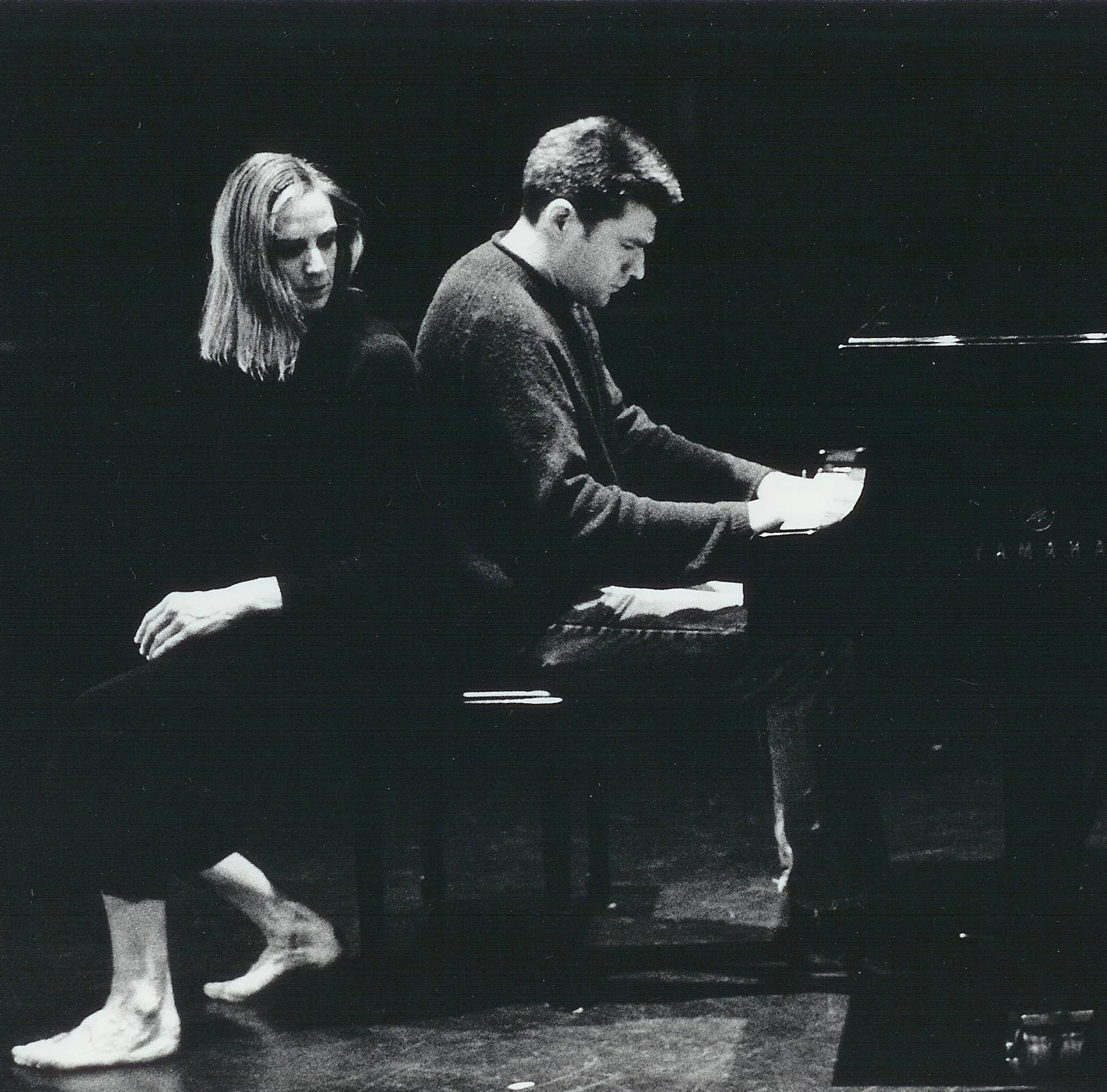
For this week’s blog, Peggy’s collaborator for twenty years, pianist Andrew Burashko looks back at their prolific partnership:
When I first met Peggy in January of 1991, I was at the threshold of a career as a concert pianist - a career I only ever imagined as a soloist, sometimes sharing the stage with other musicians - a solitary pursuit with not much room for anything else. I knew nothing of modern dance or any other kind of dance for that matter; and I only knew of Peggy Baker as the ex-wife of the composer Michael J. Baker with whom I had worked.
Peggy had just returned to Canada after a decade in New York and was looking for a pianist to perform a work that Mark Morris had given her as a gift when she left White Oak Dance Project. It was a work titled Ten Suggestions which was choreographed for solo dancer to Ten Bagatelles for solo piano by Alexander Tcherpnin. When Peggy first reached out to me, I saw it as a gig that would earn me some sustenance between ‘real’ engagements - solo recitals and concerto appearances. It seemed like a compromise - a job for a pianist incapable of commanding the stage on their own. This was my fragile, young ego talking, of course.
I remember showing up at the first rehearsal with a metronome to capture the exact tempi Peggy wanted, imagining that I would need to follow her. It was a relief to learn that she wanted me to play the music as I felt it. That was the beginning. For the next twenty years of our collaboration she encouraged me to choose the music – pieces I yearned to play – and allowed for my interpretations to inform her choreography. It was a revelation to see the music I was playing manifested in her movement. Not only in terms of her expression but also as a counterpoint. When making music with other musicians, everyone must be on the same page emotionally and intellectually. It’s not possible for one musician to be still or serene while a musical storm is raging around them. It was a shock to see her choreography seemingly contradict instead of mirror my idea of what the music was saying. It brought another level of nuance to my understanding of music.
Peggy also revealed an entirely new world to me by exposing me to the remarkable discipline and beauty of dance; and by helping me discover a new paradigm for myself as a classical musician. She brought me out of the spartan environment of the concert hall and into the magical and mysterious world of the theatre – lighting, staging, the possibilities of creating another world for the music – things I had never considered before and that I embraced and incorporated into Art of Time concerts.
The lessons were plenty and the growth profound. In short, I wouldn’t have found the path I am on today without having met Peggy.
Thank you dear friend. AB

Why the Brook Wept (1996)
As Peggy Baker and Andrew Burashko continue developing their repertoire together, Andrew suggests another John Cage score, Ophelia, composed for the American dancer Jean Erdman in 1946. Peggy writes about her response:
“That the music had been written explicitly for a choreographic portrait of Ophelia from Shakespeare’s Hamlet was both compelling and intimidating, and I hesitated to take it on. But the more I listened to the music, the more amazed and fascinated I was by the ways in which it captured Ophelia’s dilemma. Finally, I could not turn away.
To begin with, I worked strictly with the script of the play developing sequences, scenes and images based on the text. Once I had worked my way through the words I went back to the music, allowing the score to guide me in arranging, distilling, and refining the choreography. Also very much on my mind was the John Everett Millais painting Ophelia, (1851-2), which I had seen at the Tate in London many years earlier. I chose not to research the original choreography, so there are no intentional allusions to Erdman’s dance in my own. The description of Ophelia’s death as a fall “into a weeping brook” inspired my title.
One of the most potent images the music inspired for me was the idea of the pianist as Hamlet, and his performance of the score as his own wrenching self-interrogation. So the piano is positioned in profile on stage left, with the pianist’s back is to the dancer. At the end of the piece, the dancer is left on the floor, crumpled against the back legs of the piano bench, and once the final notes have decayed, the pianist closes the keyboard, stands and closes the piano’s lid and exists the stage. Whenever we performed this work, it closed the program, including on Art of Time Ensemble’s program, If music be… first staged in 2010.” PB
“The two dance sequences are beautifully rendered: Tanya Howard and Patrick Lavoie, as choreographed by James Kudelka in the Act III scene where Romeo and Juliet part after a night of lovemaking; and the remarkable Peggy Baker dancing Ophelia’s madness to music of John Cage to close the show.”
- John Terauds, The Toronto Star
"Cage composed the music for a 1946 dance by Jean Erdman, but Baker has made it her own, as much acted as danced. She passes through a full spectrum of moods, from languor to frenzy. When Burashko closes the piano and leaves her fallen figure on the stage, it is the spirit leaving the body."
- Susan Walker, The Toronto Star
To learn more about the work of John Cage watch John Cage. From Zero here on Youtube.


In a Landscape (1995)
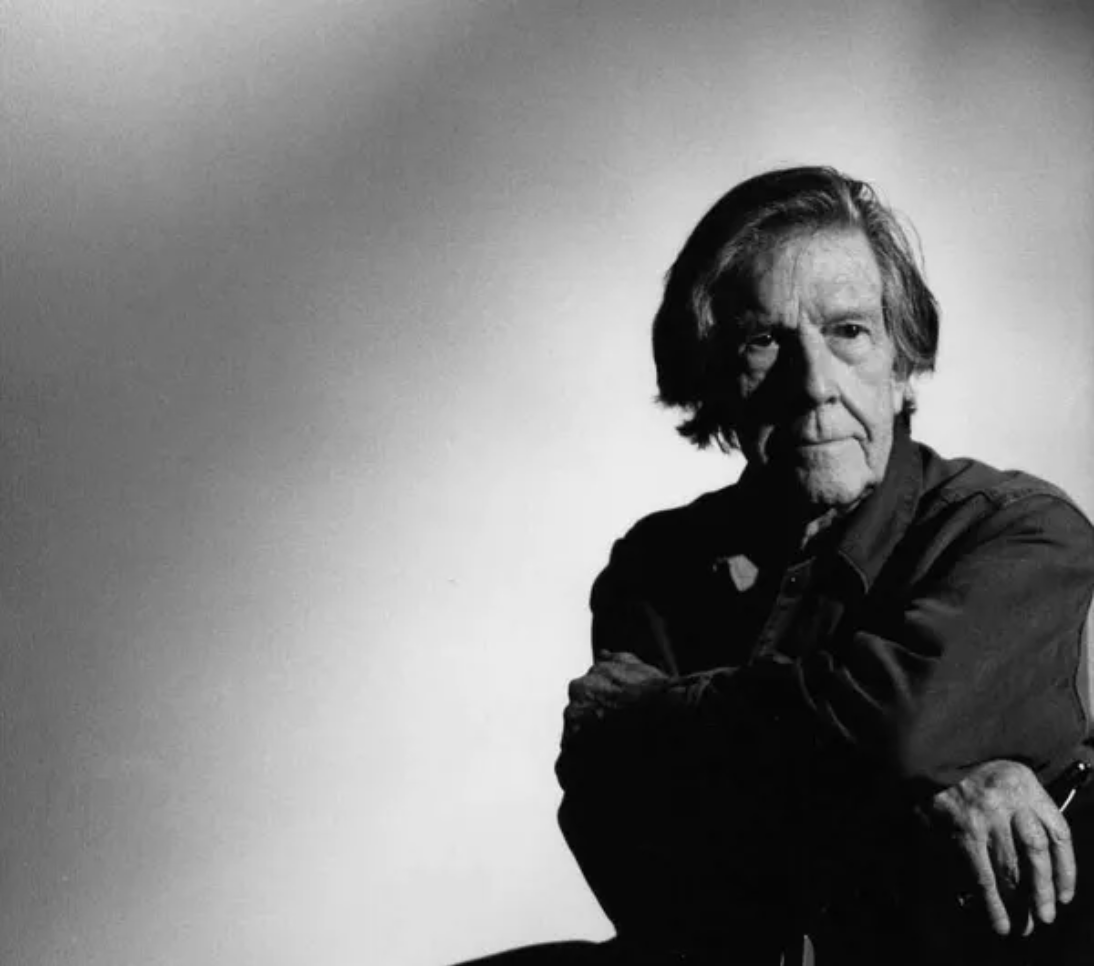
The music and influence of John Cage is peppered throughout Peggy’s work, and it all began back in 1995…
“Pianist Andrew Burashko and I often gave one another books or CDs as gifts, and for our opening night at The Kitchen in New York in 1995, he gave me a CD of solo piano music by John Cage performed by Stephen Drury. The first track on the album was a piece from 1948 entitled In a Landscape. I instantly feel in love in with the music’s gently cascading melodies and the cresting and lulls of its compositional asymmetries. I lucked into an opportunity to perform a new work for fFIDA, (Toronto’s sadly no-longer Fringe Festival of Independent Dance Artists), and because Andrew was elsewhere, teamed up with pianist Henry Kucharzyk for the premiere.
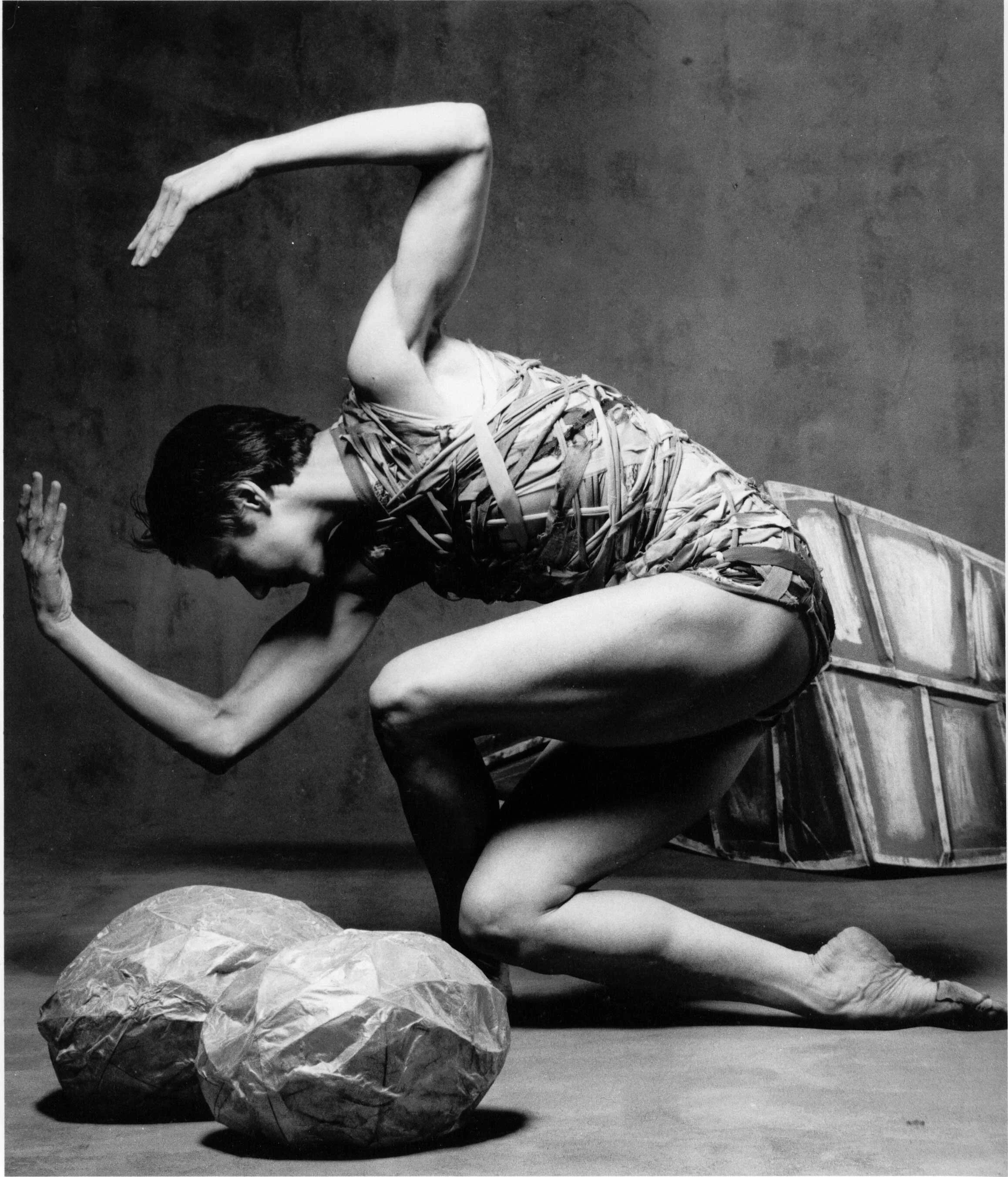
The music took me inside of what I described then as my “creature body” – an interior world of sensations and movements riding the contours of joints and the pathways of blood, bone and muscle. The cycles of ritual that emerged elicited fragile balances and distortions that carved the lines of movement like the scarring and pruning used to cultivate a bonsai. Though this dance is brief, it moves through a timeframe that opens and elongates every second. The original staging of this work included a stunning costume by Jane Townsend – a kind of cocoon for the torso that left my bare arms and legs looking like the appendages of an insect – and a set of sculptural pieces by Kurt Swinghammer, some of which glowed at various times. Marc Parent, who lit this original version, later created a completely different treatment that called on the dancer to navigate a constantly morphing circle of light (imagine a rotating lava lamp projected onto the floor) that was devilishly difficult to balance within and which gave the impression of a dancer moving on a surface sliced out of the Milky Way.
I hold dear performances of In a Landscape with Henry, and later, and over many years, with Andrew. Performances of this dance by others, most especially Christopher T. Grider, Tanya Howard and Andrea Nann, have moved me deeply. “ PB
"A finely crafted solo, with carefully articulated movement perfectly matched to a John Cage composition." - Lewis Hertzman, Dance Magazine
“The estimable Andrea Nann puts her personal stamp on Baker’s 1995 solo In a Landscape; the choreographer’s own remembered presence in the same work hovers like a distant echo.” - Michael Crabb , The Toronto Star
Listen to Kurt Swinghammer being Interviewed by Steve Waxman here on The Creationists.
Watch the documentary John Cage. From Zero here on YouTube.


Black Border with Moving Figures (1994)
Hot on the heels of the creation and performance of Brute to Prokofiev’s Sonata No. 6, Peggy and Andrew immediately embark on another ambitious project.
“I had given Andrew a copy of Wassily Kandinsky’s Concerning the Spiritual in Art and our conversations around the provocations it offered served as the entry for a new work. Kandinsky proposed the act of painting as an improvisation with colour, shape, line and form “independent from visual reality” that brought into existence a painting that communicated with the viewer on such a deep and significant level that it had the power to raise their consciousness. Andrew and I both appreciated the scope of this proposal in relation to our own art practice, and set out to dismantle in some way the framework of a dance to music. Working in silence, I developed 15 choreographic scenes, while Andrew choose works by Liszt and Chopin that place especially heavy demands for subjective interpretation on the pianist.
Coming together for rehearsal, I started with my 15 scenes in chronological order and allowed them to migrate until they were arranged in a sequence that was exciting and fascinating to dance to the music of either composer. The costume pieces for me by Caroline O’Brien could be combined in various ways and each time I exited the stage I returned in a different variation of the many possibilities.
Black Border with Moving Figures was a grand experiment that opened important and far ranging conversations between Andrew and I. It pushed us each to think about our practice differently, and expanded and deepened our collaboration. But I was never convinced by the work we made, and after the premiere in Toronto and performances at The Kitchen in New York, we set this piece aside.”
"Baker in one of her most rigorously modulated performances complementing the fire of Burashko's interpretations of Liszt and Chopin..." Michael Crabb, Toronto Star
“Peggy Baker, who is performing at the Kitchen through tomorrow night with Andrew Burashko, a pianist and fellow Canadian, is a dancer of startling power and fascination.
Audiences lost no time noticing her in Lar Lubovitch's modern dance company, where from 1981 to 1988 her big-boned dynamism was used with passionate sweep. Appearing since then as a charter member of Mikhail Baryshnikov's White Oak Dance Project and as a soloist, she has evolved into a dancer of striking physical projection.
Now in her own choreography, she knows how to focus on her expressive back and amazing long arms, fingers and legs; no one else dances with the same striking mix of formal severity, muscular force and strangely feminine allure.” Anna Kisselgoff, The New York Times
To learn more about Kandinsky, begin here at artsy.net.
If you read Ron Sexsmith’s joke in our Facebook or Instagram Creation Catalogue posts this week - and you liked it - follow @RonSexsmith on Twitter.


Brahms Waltzes (1992)
This week we arrive in 1992 and look at Peggy’s third major solo created on and for herself, the timeless Brahms Waltzes:
“An invitation to bring a solo program to Peterborough through Public Energy Performing Arts came with some commissioning money for a new work, so Brahms Waltzes marks the very first work of mine to garner to an investment in my choreographic development by a presenter – trailblazing contemporary dance champion, Bill Kimball.
Although having a pianist perform with me for the premiere far exceeded the scope of the budget for this run with Bill, the choice of an early work for piano by Johannes Brahms was certainly inspired by the possibility of having Andrew Burashko perform with me at some point in the future.
Annabelle Gamson had taught me Isadora Duncan’s dances to the same series of waltzes, and I curious to see how I might respond to the music myself. As I developed the choreography I could feel myself weighing the many influences on my dancing and asking myself what to let of go, what to go beyond, what to get deeper inside. I think I kept coming back to this dance as a kind of touchstone because it holds that time of transition so transparently.
Brahms Waltzes rides the uncomplicated joys of the music, but it also holds two central metaphors: sleep as an integrating force during a time of personal change and growth, and the demarcation of a new period in one’s life as the crossing of a threshold.” PB
"Mixes graceful lyricism with an economy of gesture and even moments of complete stillness in a solo that spans explosions of power with almost meditative serenity.” - Michael Crabb, The Toronto Star
Peggy gifted this work to Kate Holden and Jessica Runge as part of Year One of her Choreographer’s Trust project. Find out more about The Choreographer’s Trust here, and read about Kate’s reinterpretation of this piece as this body of memory / Brahms Waltzes in The Toronto Star here.
To read more about sleep as a metaphor in art and dance, read this article in The Huffington Post.


Ten Suggestions (1981/1991)
This week Peggy writes about Ten Suggestions, choreographed by Mark Morris.
“With The White Oak Dance Project, I had the extraordinary experience of dancing Ten Suggestions, a solo that choreographer Mark Morris had made for himself ten years earlier, in 1981. I had been in the audience when Mark premiered the solo at DTW (Dance Theatre Workshop, now New York Live Arts), and had been so thrilled by his performance that I went home and wrote a poem in an attempt to capture what it had felt like to witness him.
For White Oak, Mark had double cast me with one of the greatest dancers of all time, Mikhail Baryshnikov, and to be in the studio with the two of them together was as exhilarating as it was intimidating.
I gave my very first performance on a night that Misha had been scheduled to perform and when the stage manager announced the change of casting, I stood on stage behind the curtain ready to begin and heard the entire audience groan in unison. Not that I blamed them, because they had come expressly to see Baryshnikov (who did perform in every other work on the program), but oh, what a way to make a debut in a role!
When I made the decision to strike out on my own rather than continue with White Oak, Mark immediately offered Ten Suggestions to me as a gift. Can you imagine?! He gave me a dance! And in receiving that gift, the course of my creative life changed in profound ways. Mark’s work is always danced to live music, and in seeking out a pianist as my performance partner I found Andrew Burashko, who became my most constant and influential collaborator and performance partner for the next 20 years.” PB
"Ten Suggestions opens with Baker, dressed in silky pink pajamas, crouching and tumbling onto a stage otherwise occupied by a cane-backed chair, a hula hoop and a hat. The first part is all long, loose limbs, beautifully articulated by Baker...she goes on to conquer successively the various props and finally is herself whipped around by the music, as though she's become its prop. The movement is rich, almost baroque, in a thoroughly modern way, with its pure design and intricate detailing." Alina Gildner, The Globe and Mail
To read more about Mikhail Barynikov’s defection from the USSR in Toronto in 1974 visit the CBC here.


Ten Suggestions
Peggy Baker (2009)
In 1990 I was invited to join Mark Morris and Mikhail Baryshnikov’s White Oak Dance Project for its inaugural season. Among the many extraordinary gifts of that time for me was sharing a part with Baryshnikov in a charming solo called Ten Suggestions. Mark had made Ten Suggestions for himself in 1981 and I had seen the first performance at the old Dance Theatre Workshop in New York. I went home from that concert and wrote a poem that captures the touching, virtuosic, campy essence of the performance:
The man in the pink silk pajamas was spectacular;
Casals playing in the light of Liberace’s candelabra.
I saw Nijinsky dance in 1981.
Mark is a great big guy, soft and floppy and flamboyant. He tosses off impressive turns and balances with the greatest of ease and he is supremely musical. Misha is like a greyhound, small and perfectly proportioned. He is lean and muscular, and there is nothing he can’t do well. One of the greatest classical dancers of all time, he is handsome and sexy to boot. I am a tallish, angular modern dancer, somewhat androgynous. My proportions are odd, but somehow everything balances out. Depending on the dance, I tend toward extremes of either cool abstraction or deep emotion.
It was an unusual choice for Mark to cast both Misha and me in a solo he had made for himself. With no basis for comparison, because of the drastic contrasts among us, I realized that I had been in the habit of comparing myself to other dancers rather than thinking of myself purely in relation to the choreography.
Picture this: for the very first step of the dance you wait several bars, then suddenly appear from the up right wing, pull off as many pirouettes as you can in a couple of counts and then drop to a crouch. Any choreographer would dream of having Mikhail Baryshnikov for a moment like that. But whatever Misha did, I was going to have to treat it differently, because I’ve never gotten around more than three times in my entire career. The immediate and enduring lesson on that one was to focus on the dance and to consider and explore ways in which to meet the challenges of the choreography, rather than lamenting my inability to choose options that are only available to others.
I also got a better sense of the fact that sometimes it is simply the physique of a dancer that makes something work in a particular way. Mark’s lush bulk was splendid for the Duncanesque dance with a ribbon. Misha was so low and compact for the somersault / crouch phrase that it read like the kind of optical illusion a clown uses to squash his height. And my extra long arms were the perfect length for the deco sequence with the hoop. You can’t compete with that kind of thing, you can only think of it as a gift in terms of the dance.
Mark was incredibly generous in the way that he rehearsed Misha and me, taking tremendous pleasure in seeing the dance reinvented by each of us. One of my strongest memories from those rehearsals is of Mark, head thrown back, laughing his wild cackle over the delightful beauty, or crazy out-of-character look of some moment. Misha loved to talk things over with me. How did I approach this or that, what did I think of the way he had chosen to do something. Was I aware of having lost some detail or of having changed something he thought worked well. That same openness and curiosity was sustained through the performances as we supported each other with a comment or question and continued to observe each other’s work with interest and appreciation.