

Notes on a Collaboration
For this week’s blog, Peggy’s collaborator for twenty years, pianist Andrew Burashko looks back at their prolific partnership:
When I first met Peggy in January of 1991, I was at the threshold of a career as a concert pianist - a career I only ever imagined as a soloist, sometimes sharing the stage with other musicians - a solitary pursuit with not much room for anything else. I knew nothing of modern dance or any other kind of dance for that matter; and I only knew of Peggy Baker as the ex-wife of the composer Michael J. Baker with whom I had worked.
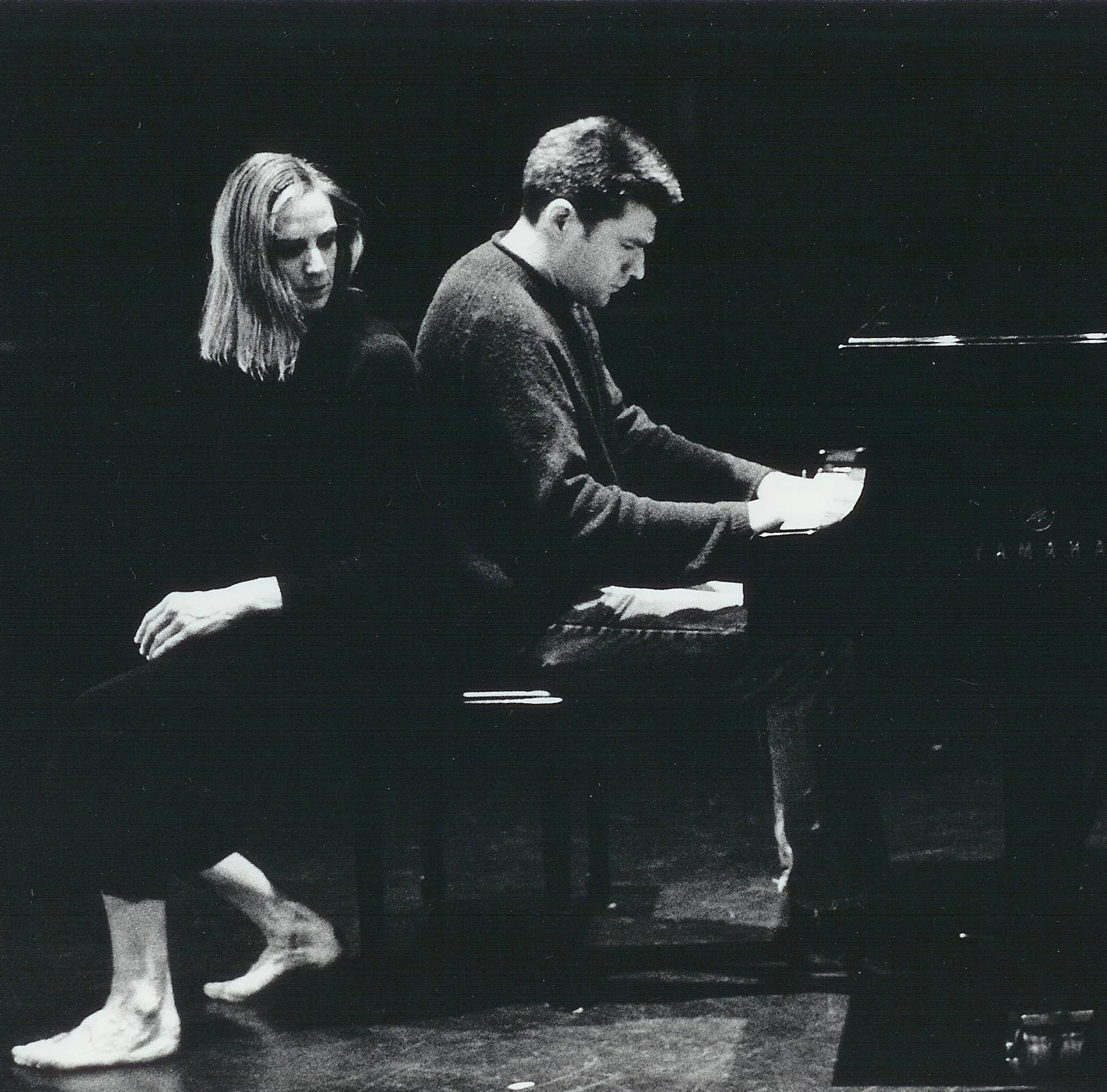
Peggy had just returned to Canada after a decade in New York and was looking for a pianist to perform a work that Mark Morris had given her as a gift when she left White Oak Dance Project. It was a work titled Ten Suggestions which was choreographed for solo dancer to Ten Bagatelles for solo piano by Alexander Tcherpnin. When Peggy first reached out to me, I saw it as a gig that would earn me some sustenance between ‘real’ engagements - solo recitals and concerto appearances. It seemed like a compromise - a job for a pianist incapable of commanding the stage on their own. This was my fragile, young ego talking, of course.
I remember showing up at the first rehearsal with a metronome to capture the exact tempi Peggy wanted, imagining that I would need to follow her. It was a relief to learn that she wanted me to play the music as I felt it. That was the beginning. For the next twenty years of our collaboration she encouraged me to choose the music – pieces I yearned to play – and allowed for my interpretations to inform her choreography. It was a revelation to see the music I was playing manifested in her movement. Not only in terms of her expression but also as a counterpoint. When making music with other musicians, everyone must be on the same page emotionally and intellectually. It’s not possible for one musician to be still or serene while a musical storm is raging around them. It was a shock to see her choreography seemingly contradict instead of mirror my idea of what the music was saying. It brought another level of nuance to my understanding of music.
Peggy also revealed an entirely new world to me by exposing me to the remarkable discipline and beauty of dance; and by helping me discover a new paradigm for myself as a classical musician. She brought me out of the spartan environment of the concert hall and into the magical and mysterious world of the theatre – lighting, staging, the possibilities of creating another world for the music – things I had never considered before and that I embraced and incorporated into Art of Time concerts.
The lessons were plenty and the growth profound. In short, I wouldn’t have found the path I am on today without having met Peggy.
Thank you dear friend. AB

Beautiful Day (1992)
The final work from 1992 is Beautiful Day, a duet by Mark Morris, created in part on members of his company, and in part on Peggy and her duet partner for this piece, Christopher House.
“It was with no small measure of regret that I left The White Oak Dance Project and the company’s repertoire of magnificent dances by Mark Morris. So once I was settled in Toronto I contacted Mark to ask if he might make a duet for Christopher House and me. I hadn’t yet had the chance to dance with Christopher, and I thought a duet by Mark would be a spectacular way of thanking him for The Windows, the solo he made for me in 1989. I also thought it would be a way of sharing some part of the incredible world that had opened up for me during my time in New York.
Mark had just begun a new duet with some of his company dancers – work he would have to interrupt to fulfill a commission for Les Grands Ballets Canadiens – and he suggested that Christopher and I work with him in Montreal, learning the first half of the duet from video of his dancers and then finishing the work with us to take back to his company. The time together was absolutely magical, and the duet a jewel!” PB
“I was working on Beautiful Day with three couples from my company, the Mark Morris Dance Group, at the same time as I was working in Montreal with Les Grands. Peggy, Christopher House, Teri Weksler (as my assistant) and I worked together to finish the piece. It was premiered by my dancers (originally Clarice Marshall and Keith Sabado) at the Manhattan Center Grand Ballroom in 1992. The dance gets its title, and is set to, the aria “Schlage doch, gewünste stunde” from a rarely performed cantata (attributed to J.S. Bach, but unlikely) for alto voice, strings, and handbells. It is built on a study in combining angular momentum with spiral force, whatever that means. I must say, it was an enormous pleasure to work with Peggy and Christopher, both fabulous dancers, Canadian National Living Treasures, and my friends. And it’s a beautiful dance.” MM
Listen to a 1992 CBC radio interview with Peggy and host Vicki Gabereau here.
Read more about Melchior Hoffman, the more likely composer of the music than J. S. Bach here on Wikipedia
Read about the history of the Manhattan Center Grand Ballroom in The New Yorker here.


Ten Suggestions (1981/1991)
This week Peggy writes about Ten Suggestions, choreographed by Mark Morris.
“With The White Oak Dance Project, I had the extraordinary experience of dancing Ten Suggestions, a solo that choreographer Mark Morris had made for himself ten years earlier, in 1981. I had been in the audience when Mark premiered the solo at DTW (Dance Theatre Workshop, now New York Live Arts), and had been so thrilled by his performance that I went home and wrote a poem in an attempt to capture what it had felt like to witness him.
For White Oak, Mark had double cast me with one of the greatest dancers of all time, Mikhail Baryshnikov, and to be in the studio with the two of them together was as exhilarating as it was intimidating.
I gave my very first performance on a night that Misha had been scheduled to perform and when the stage manager announced the change of casting, I stood on stage behind the curtain ready to begin and heard the entire audience groan in unison. Not that I blamed them, because they had come expressly to see Baryshnikov (who did perform in every other work on the program), but oh, what a way to make a debut in a role!
When I made the decision to strike out on my own rather than continue with White Oak, Mark immediately offered Ten Suggestions to me as a gift. Can you imagine?! He gave me a dance! And in receiving that gift, the course of my creative life changed in profound ways. Mark’s work is always danced to live music, and in seeking out a pianist as my performance partner I found Andrew Burashko, who became my most constant and influential collaborator and performance partner for the next 20 years.” PB
"Ten Suggestions opens with Baker, dressed in silky pink pajamas, crouching and tumbling onto a stage otherwise occupied by a cane-backed chair, a hula hoop and a hat. The first part is all long, loose limbs, beautifully articulated by Baker...she goes on to conquer successively the various props and finally is herself whipped around by the music, as though she's become its prop. The movement is rich, almost baroque, in a thoroughly modern way, with its pure design and intricate detailing." Alina Gildner, The Globe and Mail
To read more about Mikhail Barynikov’s defection from the USSR in Toronto in 1974 visit the CBC here.


Ten Suggestions
Peggy Baker (2009)
In 1990 I was invited to join Mark Morris and Mikhail Baryshnikov’s White Oak Dance Project for its inaugural season. Among the many extraordinary gifts of that time for me was sharing a part with Baryshnikov in a charming solo called Ten Suggestions. Mark had made Ten Suggestions for himself in 1981 and I had seen the first performance at the old Dance Theatre Workshop in New York. I went home from that concert and wrote a poem that captures the touching, virtuosic, campy essence of the performance:
The man in the pink silk pajamas was spectacular;
Casals playing in the light of Liberace’s candelabra.
I saw Nijinsky dance in 1981.
Mark is a great big guy, soft and floppy and flamboyant. He tosses off impressive turns and balances with the greatest of ease and he is supremely musical. Misha is like a greyhound, small and perfectly proportioned. He is lean and muscular, and there is nothing he can’t do well. One of the greatest classical dancers of all time, he is handsome and sexy to boot. I am a tallish, angular modern dancer, somewhat androgynous. My proportions are odd, but somehow everything balances out. Depending on the dance, I tend toward extremes of either cool abstraction or deep emotion.
It was an unusual choice for Mark to cast both Misha and me in a solo he had made for himself. With no basis for comparison, because of the drastic contrasts among us, I realized that I had been in the habit of comparing myself to other dancers rather than thinking of myself purely in relation to the choreography.
Picture this: for the very first step of the dance you wait several bars, then suddenly appear from the up right wing, pull off as many pirouettes as you can in a couple of counts and then drop to a crouch. Any choreographer would dream of having Mikhail Baryshnikov for a moment like that. But whatever Misha did, I was going to have to treat it differently, because I’ve never gotten around more than three times in my entire career. The immediate and enduring lesson on that one was to focus on the dance and to consider and explore ways in which to meet the challenges of the choreography, rather than lamenting my inability to choose options that are only available to others.
I also got a better sense of the fact that sometimes it is simply the physique of a dancer that makes something work in a particular way. Mark’s lush bulk was splendid for the Duncanesque dance with a ribbon. Misha was so low and compact for the somersault / crouch phrase that it read like the kind of optical illusion a clown uses to squash his height. And my extra long arms were the perfect length for the deco sequence with the hoop. You can’t compete with that kind of thing, you can only think of it as a gift in terms of the dance.
Mark was incredibly generous in the way that he rehearsed Misha and me, taking tremendous pleasure in seeing the dance reinvented by each of us. One of my strongest memories from those rehearsals is of Mark, head thrown back, laughing his wild cackle over the delightful beauty, or crazy out-of-character look of some moment. Misha loved to talk things over with me. How did I approach this or that, what did I think of the way he had chosen to do something. Was I aware of having lost some detail or of having changed something he thought worked well. That same openness and curiosity was sustained through the performances as we supported each other with a comment or question and continued to observe each other’s work with interest and appreciation.

This Isn't The End (1991)
The second commissioned work from James Kudelka in Peggy Baker Dance Projects’ repertoire, This Isn’t The End has a decidedly kooky edge to it. Explaining the method to his madness, James writes:
”When Peggy asked me to help oversee an evening at the PDT* that would include Romeo and Juliet Before Parting I thought it was important that the program include something with whimsy. For me, contemporary dance programs always had a tendency to take themselves very seriously. Creating something lighter and whimsical would be a challenge for us both.
The score of This Isn’t the End was created by John Oswald who wrote three pieces based on re-edits of readings of Agatha Christie mystery novel talking books - a garbled recreation of a few murder scenarios. And I asked Peggy to play the role of an old fashioned nurse, in white lab coat and striped hat. Peggy collected some wonderful props to go with that, and Marc Parent lit the stage with exposed fluorescent institutional lighting. The dance was unusual and surprising and answered the call for some lightness, and mystery - and accessibility - but it was also a little insane.” JK
Peggy adds: “Thinking back on This Isn’t the End, what really stands out is the joy of the rehearsals, all of the laughter James and I shared. I was wearing the costume with all of its many pieces early on in rehearsals — lingerie, white stockings, zip-front nurse’s uniform, snap-closure lab coat, lace-up shoes, fold-and-button nurse’s cap — and we laughed over the comparison to Jean-Pierre Perrault’s dancers, wearing their shirts, suits and ties, coats, hats and boots in rehearsal for JOE. We were the ridiculous to their sublime!
In addition to the elaborate costume there were props galore, each used in a multitude of ways — a watch, a pen, latex gloves, a surgical mask, a stethoscope, a huge syringe, a condom I inflated and sent aloft… and in a nod to Mark Morris’s Ten Suggestions, (which also had many props to manipulate) James once referred to This Isn’t the End as One Hundred and Ten Suggestions.
James also made one of these Agatha Christie mystery dances for Patricia Fraser, and though our solos were never danced on the same program, she does leave her shoes behind her when she exits the stage at the end of her solo, and there is a (mysterious) pair of shoes onstage when my solo begins.” PB
A case for Miss Marple indeed.
For more information about composer John Oswald’s plunderphonic sampling style (and to see what websites used to look like in the olden days) visit plunderphonics.com.
* Premiere Dance Theatre, now the Fleck Theatre at Harbourfront.


Welcome to the Creation Catalogue Blog!
We’re currently building a brand new website that Peggy has titled The Creation Catalogue. It will be an online searchable archive that documents more than 30 years of creation, production, touring and professional development undertaken by Peggy Baker Dance Projects.
The Creation Catalogue Blog will post features on the company’s history from Peggy and guest contributors. Our inaugural post is of course from the company’s founding artistic director, principal dancer until 2010, and now choreographer and choreographic director, Peggy Baker:
The photograph we’re using for the banner of The Creation Catalogue was taken by Josef Astor in New York City in 1992. Lise Friedman – a former Cunningham dancer who was then the editor of the award-winning quarterly, Dance Ink – arranged a shoot with Josef for a photo feature in the publication. I was instructed to arrive at a side door of Carnegie Hall, take the elevator to the sixth floor, then find a back staircase and climb a few steps to arrive on the eighth floor. (How does that work?) The apartments and studios of Carnegie Hall were famous for the artists living and working there and, (feeling like I really had no business being there), I hesitantly roamed the maze of corridors until I found Josef’s door. I knocked at a tempo approximating my nervous heartbeat. A tall and exceedingly handsome man with a glowing smile threw open his door to me. Light streamed through a huge slanting skylight onto the studio floor and a seamless paper backdrop. Josef took movement portraits of me in costume for my dance Sanctum, Mark Morris’s Beautiful Day, and Accident by Annabelle Gamson. I had also brought a long, deep purple stretch velour dress that I had found in a sale bin at Vivienne Westwood’s Soho shop a couple of days earlier and I put in on to improvise for the camera. The moment that Josef caught in this photo inspired the second of four dances in Her Heart, choreographed the next year. - PB
For more reading on Josef Astor and his Carnegie Hall studio, visit improvised life here.
Photos below of Peggy Baker by Josef Astor, appeared in Dance Ink Fall 1992 issue Vol 3 No. 3.


